

Your Discord server hit 3,000 members after your token launch. The announcement channel is flooded with price speculation, legitimate questions get buried in general chat, and your mod team is burning out from manual verification requests. Meanwhile, your competitors are running servers with 10x the activity but half the drama.
This is the reality of discord community management crypto teams face every day. According to CoinTelegraph‘s crypto industry analysis, Discord remains the primary community platform for over 70% of new token launches, yet most projects underestimate the operational complexity of running an active server. Building a thriving Discord community isn’t about member count. It’s about creating a structured environment where holders feel informed, traders get real-time updates, and genuine community forms around your protocol.
The difference between a dead Discord server and one that drives protocol adoption comes down to systems. Not personality, not hype cycles, but repeatable workflows for moderation, verification, engagement, and crisis management. This guide walks through the exact framework successful crypto projects use to turn Discord from a cost center into a strategic growth channel.
Last updated: August 2026
What You’ll Need Before Starting
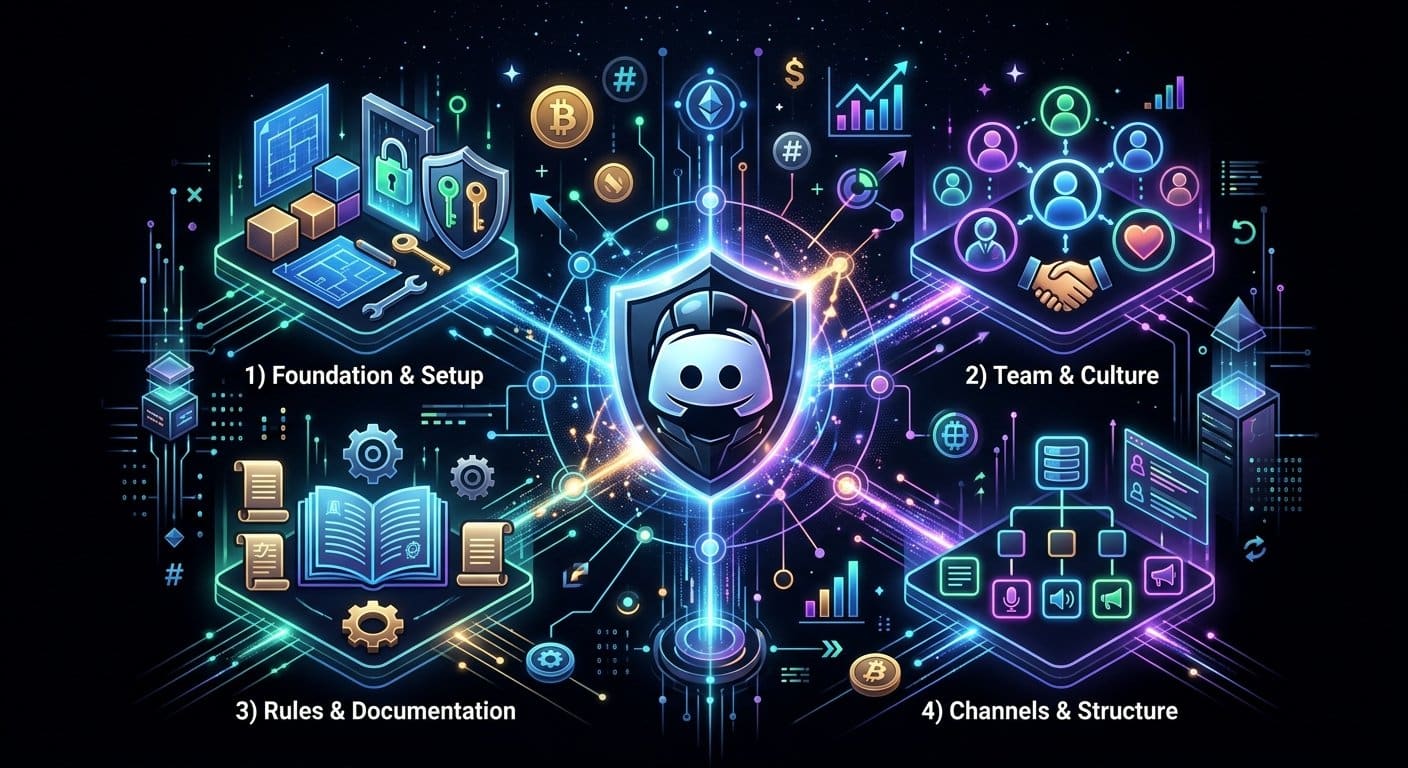
Before you build out your discord community management crypto infrastructure, audit what you already have. Most teams jump straight to bot configuration without mapping their actual community needs.
Here’s what you need in place first:
- Dedicated moderation team: Minimum 3 moderators across time zones, with at least one covering peak Asian trading hours (12am-8am UTC). Don’t rely on volunteers in the first 90 days.
- Clear protocol documentation: FAQs, tokenomics explainer, roadmap timeline. Your mods will reference these 50+ times per day.
- Bot infrastructure budget: Plan $100-300 monthly for premium bot subscriptions (MEE6 Premium, Collab.Land, custom verification bots).
- Crisis communication plan: Pre-written templates for exchange listings, security incidents, and FUD attacks. You won’t have time to craft messages during a crisis.
- Analytics access: StatBot or similar for tracking message volume, active users, and channel engagement patterns.
Most importantly, you need founder commitment. If your core team doesn’t engage in Discord at least once daily, community members notice. From campaign data we have observed across multiple Web3 projects, founder presence in community channels correlates directly with member retention during bear market cycles.
Step 1: Design Your Server Architecture for Crypto Communities
The biggest mistake in discord community management crypto projects make is copying another project’s channel structure without understanding why it was built that way. A DeFi protocol needs different channels than a meme coin. An L1 blockchain needs different structure than a GameFi token.
Start with these core channel categories:
Information Channels (Read-Only)
- #announcements: Protocol updates, partnership news, exchange listings
- #official-links: Verified links only, pinned and locked to prevent scam links
- #roadmap: Visual timeline updated monthly
- #tokenomics: Supply schedule, vesting, utility breakdown
Discussion Channels (Active Engagement)
- #general: Open conversation, loosely moderated
- #trading: Price discussion isolated from general to prevent spam
- #technical: For developers and power users asking protocol questions
- #governance: DAO proposals and voting discussion (if applicable)
Support Channels
- #help-desk: Ticket system using a bot like Ticket Tool
- #faqs: Automated responses to common questions
- #scam-reports: Community-submitted phishing attempts
Channel structure should match your project phase. Pre-launch projects need hype and community building channels (#memes, #content-creators, #ambassador-program). Post-launch projects need support and technical depth (#bug-reports, #api-documentation, #integration-partners).
Role Structure That Scales
Your role hierarchy determines who can speak where and creates status incentives. Here’s a proven structure:
- Team roles: @Founder, @Core Team, @Moderator (color-coded, hoisted to top of member list)
- Verification tiers: @Verified (passed basic captcha), @Holder (owns tokens, verified via Collab.Land), @Whale (holds 100K+ tokens)
- Engagement roles: @Active Member (500+ messages), @OG (joined in first month), @Contributor (submitted bug reports or content)
- Special access: @Early Supporter (pre-sale participants), @Tester (mainnet beta access), @Node Operator (if applicable)
Avoid vanity roles that serve no function. Every role should either grant channel access, signal reputation, or provide utility. In practice, communities with 15+ meaningless roles see lower engagement because new members feel excluded from an arbitrary hierarchy.
Step 2: Implement Automated Verification and Anti-Scam Measures
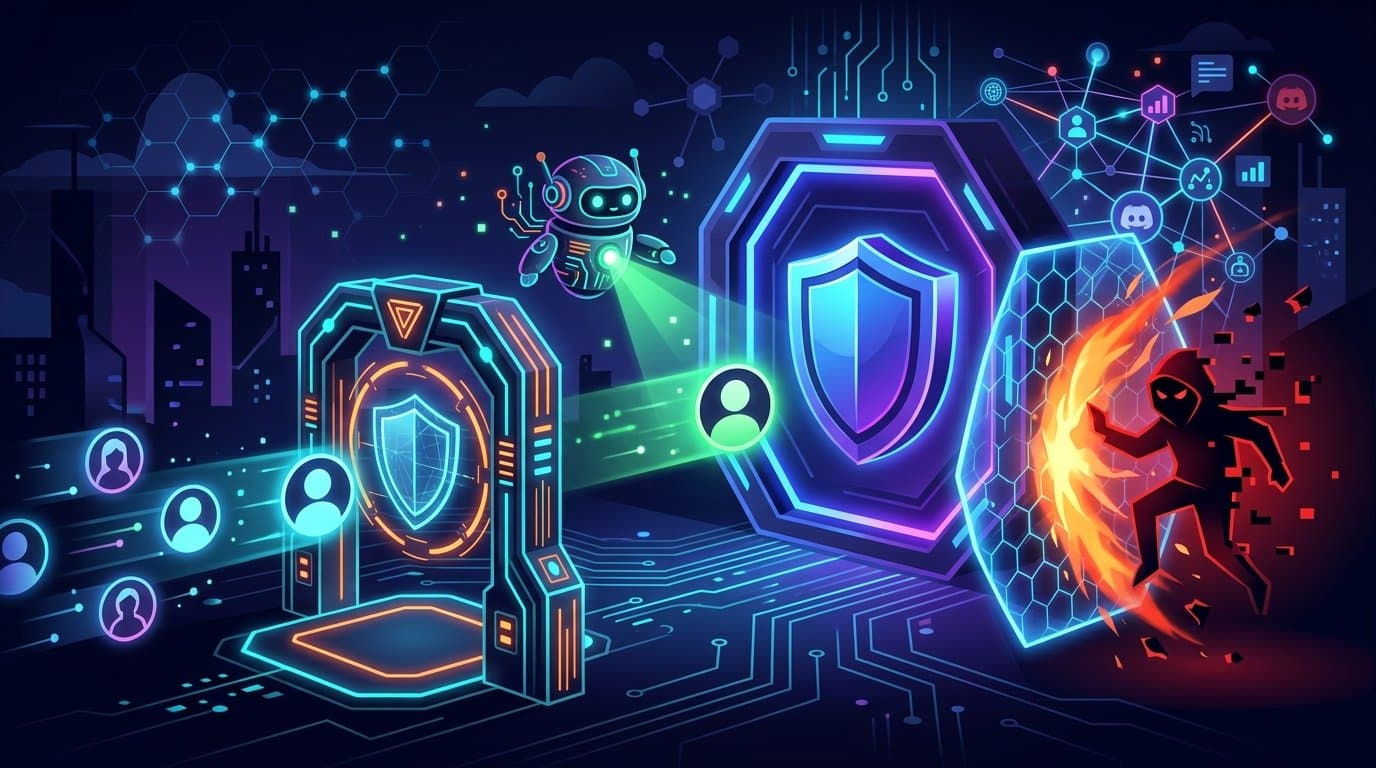
Unverified Discord servers become scam magnets within 48 hours of launch. The pattern is consistent: bot accounts join, DM members with fake support messages, drain wallets. Your verification system is the first line of defense in discord community management crypto operations.
Multi-Layer Verification Process:
Layer 1: Captcha Entry
Use Wick, AltDentifier, or Beemo for initial captcha verification. This blocks 95% of bot accounts. New members land in #verify-here, solve a captcha, then gain access to read-only channels.
Layer 2: Token Holder Verification
Integrate Collab.Land or Guild.xyz to verify wallet holdings. Members connect their wallet, prove token ownership, and automatically receive @Holder role with access to holder-only channels. Update verification thresholds as your token price changes (nobody wants to buy $5,000 worth of tokens just to access a Discord).
Layer 3: Age and Activity Gates
Set minimum account age requirements (7-14 days) and require 10-20 messages before accessing trading or giveaway channels. This prevents fresh scam accounts from immediately posting phishing links.
Anti-Scam Configuration
Configure these security settings immediately:
- Disable DMs from non-friends: Pin instructions in #welcome teaching members how to block DMs from server members
- Link filtering: Whitelist only official links (your website, verified exchanges, documentation). Auto-delete anything else with message logging for mod review
- Mention limits: Set max 5 mentions per message to prevent spam
- Raid protection: Enable Discord’s native verification gate requiring new members to read rules before accessing channels
- Image posting restrictions: Require 50+ messages before image posting permissions to prevent porn spam raids
According to research from Investopedia, crypto investors lose millions annually to Discord-based phishing. Your server security isn’t paranoia, it’s a fiduciary responsibility to your community.
Step 3: Build Your Moderation Team and Training Protocol
Moderators make or break discord community management crypto efforts. Bad mods kill community culture by being too aggressive, deleting legitimate criticism, or playing favorites. Absent mods let the server devolve into spam and price speculation.
Hire or recruit moderators who already hold your token and actively participate in the community. Don’t hire professional Discord mods from gig platforms unless you’ve exhausted community candidates. Why? Because mods who genuinely care about the protocol make better judgment calls during FUD cycles.
Moderator Requirements:
- Active during specific time zones (map your member activity heatmap using StatBot first)
- Holds minimum token threshold showing financial alignment
- Technical literacy to answer basic protocol questions without escalating everything to core team
- Emotional maturity to handle hostile community members without escalating conflicts
Pay your mods. Monthly compensation in tokens (with vesting) or stablecoin stipends. Unpaid volunteer mods burn out in 2-3 months, right when your community needs them most. Budget $500-1,500 per active mod monthly depending on server size and responsibilities.
Moderation Escalation Playbook
Create a written escalation guide mods can reference in real-time:
Low severity (warning only):
- Off-topic spam in main channels
- Excessive caps or emoji spam
- Minor rule violations (posting in wrong channel)
Medium severity (24-hour timeout):
- FUD spreading without evidence
- Personal attacks on community members
- Repeated rule violations after warning
High severity (immediate ban):
- Posting scam links or impersonating team
- Coordinated FUD or raid behavior
- Doxxing community members or team
- Pump and dump schemes or paid shilling for competing tokens
Most controversies come from inconsistent enforcement. Two members break the same rule, one gets banned and one gets warned. The banned member screenshots it, posts on Twitter, and suddenly you’re dealing with “power-tripping mods” drama. Consistency matters more than severity.
Step 4: Deploy Strategic Bot Automation
Manual discord community management crypto operations don’t scale past 1,000 active members. You need bot automation for repetitive tasks so your human mods focus on complex situations.
Essential Bots for Crypto Communities:
MEE6 or Dyno (General Moderation):
Auto-moderation rules, custom commands, level-based role assignments. Use for auto-responses to common questions (#tokenomics → link to tokenomics page, #airdrop → “no airdrop planned”).
Collab.Land (Token Gating):
Verifies wallet holdings and auto-assigns roles based on token balance. Essential for creating holder-only channels. Updates roles automatically as members buy or sell.
Ticket Tool or ModMail (Support Tickets):
Creates private support threads when members react to a message. Prevents support requests from cluttering public channels. Track resolution time and common issues.
Tatsu or Arcane (Engagement Gamification):
Awards XP and levels for participation. Members unlock new channels and roles by being active. Creates retention incentive beyond token price.
StatBot or ServerStats (Analytics):
Tracks message counts, active users, peak hours, channel engagement. Essential data for optimizing channel structure and mod schedules.
Sesh or Apollo (Event Scheduling):
Creates event calendars for AMAs, launch dates, governance votes. Members can RSVP and receive notifications.
Custom Bot Development
Once your community hits 5,000+ members, consider custom bot development for project-specific needs:
- Price bots that post token price updates to a dedicated channel (pulled from DEX or CoinGecko API)
- Whale alert bots that notify when large transactions occur on-chain
- Governance bots that post snapshot proposals and voting reminders
- Content aggregation bots that pull your project mentions from Twitter or Reddit
Custom bots cost $2,000-8,000 for initial development plus $200-500 monthly for hosting and maintenance. Only invest if you have specific requirements existing bots can’t handle.
Step 5: Create Content Systems That Drive Engagement
Active discord community management crypto strategies go beyond moderation. You need systems that generate organic conversation and keep members coming back daily.
Daily Content Pillars:
Morning Market Brief:
Post at 9am UTC in #announcements. Brief summary of overnight market moves, protocol metrics update (TVL, active wallets, volume), and any industry news affecting your sector. Format as embedded message with clean visual hierarchy. Takes 15 minutes to prepare, drives consistent engagement.
Weekly AMA Series:
Host live AMAs every week with rotating focus: technical AMAs with developers, business development updates with partnerships team, ecosystem spotlights with projects building on your protocol. Announce 48 hours in advance, pin in #events, and record for those who can’t attend live.
Community Spotlight:
Feature active community members, quality content creators, or notable holders. Post in dedicated #spotlight channel. This creates social proof and rewards positive contribution beyond price speculation.
Educational Content Series:
Many holders don’t fully understand your protocol. Create weekly educational content: “How to stake”, “Understanding our tokenomics”, “Security best practices”, “Governance voting guide”. Post as threaded discussions where community can ask questions.
User-Generated Content Programs
The best discord community management crypto programs turn community into content machines:
Meme Contests:
Weekly themed meme contests with token prizes. Winners get featured in #meme-hall-of-fame and official Twitter. Budget 0.1-0.5% of marketing budget monthly.
Ambassador Program:
Recruit 10-20 super users to create content, host regional community channels, and represent your project in other Discords. Compensate with monthly token allocations and special roles. Working with a Crypto Marketing Agency can help structure effective ambassador programs that scale.
Bug Bounty Channel:
Create #bug-reports where community can submit technical issues. Reward legitimate finds with token bounties. This turns your community into QA and makes members feel ownership.
Content Creator Pipeline:
Identify community members creating YouTube videos, Twitter threads, or Medium articles about your protocol. Give them early access to announcements and technical resources. Feature their content in #community-content. Many successful Youtube Crypto Influencers started as community members before becoming professional creators.
Step 6: Establish Crisis Communication Protocols
The quality of your discord community management crypto operations gets tested during crisis moments: security exploits, exchange delistings, major market crashes, team departures, competitive attacks, or regulatory scrutiny.
Most teams freeze during crises. Messages go silent for hours while the team scrambles internally. Community panics. FUD spreads. Token dumps. By the time you post an update, the narrative is already set by speculators.
Crisis Response Framework:
First 15 Minutes (Acknowledgment):
Post immediately in #announcements that you’re aware of the situation and investigating. Don’t wait for complete information. A holding statement like “We’re aware of reports about X. Team is investigating and will provide update within 2 hours” prevents panic and shows you’re responsive.
Hour 1-2 (Initial Update):
Post what you know so far, what you don’t know yet, and immediate actions being taken. Be transparent about uncertainty. “We’ve confirmed X happened. We’re still investigating Y. We’ve paused Z as a precaution” is better than radio silence.
Hour 3-6 (Action Plan):
Share the resolution plan or mitigation steps. Include timeline for next update. If it’s a security issue, include immediate actions users should take (revoke approvals, move funds, etc.).
Post-Crisis (Post-Mortem):
Within 48 hours, post detailed post-mortem explaining what happened, why, and steps to prevent recurrence. This builds trust and shows operational maturity.
Pre-Written Crisis Templates
Create message templates in advance for common scenarios:
- Exchange listing/delisting: Explain what it means for holders, alternative trading venues, and next steps
- Smart contract vulnerability: Immediate protective actions users must take, technical explanation, remediation plan
- Regulatory announcement: Context on what changed, legal analysis, impact on project operations
- Partnership dissolution: Reason for split, impact on roadmap, alternative paths forward
- Major market crash: Macro context, protocol health metrics (TVL, active users), long-term conviction message
During a crisis, you’re operating under extreme stress and time pressure. Templates ensure you communicate key information without omitting critical details.
Step 7: Segment Your Community with Token-Gated Channels
Not all Discord members should access the same content. Segmentation creates value tiers that incentivize holding and rewards your most committed community members.
Public Channels (No Token Required):
- #welcome, #rules, #announcements
- #general, #introductions
- Basic education channels
Open access generates awareness and lets people evaluate your project before buying. Don’t gate everything or you limit growth.
Verified Holder Channels (Any Token Amount):
- #holder-chat: General discussion for verified holders only, reduces sybil attacks and low-quality chat
- #governance: Proposal discussions and voting coordination
- #technical-deep-dive: Advanced protocol mechanics and integration questions
This tier filters out tourists and creates space for substantive discussion. Set verification threshold low enough that anyone genuinely interested can participate (even $100 worth of tokens).
Whale Channels (Top 5-10% of Holders):
- #alpha-access: Early announcement preview, direct founder Q&A
- #whale-lounge: Social space for large holders
- #institutional: For VCs, funds, and large allocators
Whale channels keep your largest holders engaged and give them status recognition. They become defenders during FUD because they have invested identity in the community, not just capital.
Contributor Channels (Activity-Based):
- #ambassadors: For official program participants
- #content-creators: For those producing promotional content
- #developers: For those building on your protocol
These roles aren’t token-gated but activity-gated. Assign manually based on contribution.
Token-Gating Best Practices
Use Collab.Land or Guild.xyz to verify holdings and auto-assign roles. Update thresholds quarterly based on token price. If your token 10x’s, a whale threshold that made sense at $0.10 might exclude genuine supporters at $1.00.
Never gate support channels. Anyone should be able to ask for help regardless of holdings. Gating support is terrible optics and creates “holders vs non-holders” toxicity.
Step 8: Implement Data-Driven Engagement Optimization
Effective discord community management crypto strategies require measurement. You can’t optimize what you don’t track.
Key Metrics to Monitor Weekly:
Active Users:
Members who post at least once per week. Track trend over time. Declining active users despite growing member count signals engagement problems. Tools like StatBot or MEE6 analytics dashboard track this automatically.
Message Volume by Channel:
Which channels drive conversation? Which are dead? Kill or merge low-activity channels monthly. If #technical only gets 5 messages per week, merge it into #general with a technical tag system.
Peak Activity Hours:
When is your community most active? Schedule AMAs, announcements, and content drops during peak hours for maximum engagement. Most crypto communities peak between 2pm-6pm UTC and 9pm-1am UTC (covering European afternoon and US evening).
Response Time:
How long until a question in #help-desk gets answered? Target under 30 minutes during business hours. Slow response times frustrate users and create negative social proof (other members see unanswered questions and assume the team is unresponsive).
Retention Rate:
What percentage of new members are still active after 7 days? After 30 days? If 90% of new members never post again, your onboarding or community culture needs work.
Sentiment Analysis:
Are conversations mostly positive, neutral, or negative? Track qualitatively by reading random samples daily. Declining sentiment predicts price drops and requires intervention.
A/B Testing Content Strategy
Test different engagement tactics and measure results:
- Post announcements at different times and track reaction counts
- Try different AMA formats (text vs voice, structured vs open) and measure attendance
- Experiment with gamification rewards (role unlocks vs token prizes) and track participation
- Test different mod response styles and measure how it affects de-escalation success rate
Most teams run Discord on intuition. Data-driven optimization compounds over time and separates thriving communities from dead ones.
Step 9: Coordinate Discord with Broader Marketing Channels
Your Discord doesn’t exist in isolation. It’s one piece of your community ecosystem alongside Twitter, Telegram, Reddit, and content platforms. The most effective discord community management crypto operations coordinate across channels.
Cross-Platform Content Flow:
Twitter → Discord:
Share major Twitter announcements in Discord #announcements with context and room for discussion. Twitter is for reach, Discord is for depth. A product launch announcement on Twitter should link to a Discord thread where community can ask technical questions.
Discord → Twitter:
Surface top community memes, questions, or insights from Discord to Twitter. This rewards Discord participants with visibility and shows Twitter followers the vibrant community. Tag community members when sharing their content externally (if they’re comfortable with it).
YouTube → Discord:
When you or community creators publish explainer videos, tutorials, or project updates, share in Discord #content with discussion prompts. Create watch parties for major announcements. Consider working with established Crypto Influencers who can drive their audiences to your Discord community.
Discord → Product:
Use Discord as beta testing ground. Give Discord holders early access to new features, collect feedback in dedicated channels, and iterate based on input. This creates ownership and turns community into evangelists.
Telegram vs Discord Strategy
Many projects run both Telegram and Discord. This creates fragmentation but serves different audiences. In practice, Asian communities prefer Telegram while Western communities prefer Discord. Rather than fight this, optimize each for its audience:
Telegram focus: Fast updates, price discussion, trading signals, quick community polls
Discord focus: Deep technical discussions, governance deliberation, community events, content creation
Cross-post major announcements to both, but don’t try to mirror all activity. Let each platform develop its own culture. Appoint a community lead responsible for each platform to prevent one from becoming neglected.
If you’re evaluating your overall marketing mix, a professional Best Crypto Marketing Agency can help determine optimal channel allocation based on your target audience and project stage.
Step 10: Launch Strategic Campaigns to Reactivate Dormant Members
Most Discord communities experience engagement decay over time. Early enthusiasm fades. Members stop participating even though they remain in the server. Smart discord community management crypto teams run reactivation campaigns quarterly.
The Dormant Member Challenge:
Segment your member list into activity tiers using MEE6 or StatBot:
- Active: Posted in last 7 days
- Semi-active: Posted in last 30 days but not last 7
- Dormant: Joined but haven’t posted in 30+ days
- Dead weight: Joined 90+ days ago, zero messages ever
Your goal is moving semi-active members back to active, and re-engaging a portion of dormant members. Dead weight can be pruned (explained below).
Reactivation Campaign Tactics:
Tagged Announcement Campaigns:
Post an exciting announcement (partnership, feature launch, exchange listing) and use @everyone or @here tags to generate notification. Use sparingly (maximum once per week) or you train people to mute notifications.
Exclusive Holder Events:
Announce a special event only for verified holders: exclusive AMA with a notable partner, early feature access, or airdrop snapshot. This creates urgency and reminds dormant holders why they’re in the server.
Gamified Re-Engagement:
Launch a week-long activity challenge: “Post once daily for 7 days to earn [role/badge/token reward]”. Gamification triggers competitive psychology and creates habit formation.
Community Survey:
Post a survey asking members why they’ve been less active: “Is it the content? The vibe? Timezone issues?” Use Google Forms or Typeform. Share results publicly and implement suggested changes. This shows you value feedback.
Server Boost Campaigns
Discord server boosts unlock features like better audio quality, more emoji slots, and custom server banners. These matter more than you’d think. They signal investment and professionalism.
Run campaigns to hit boost thresholds:
- Level 1 (2 boosts): Better emoji and 50 extra emoji slots
- Level 2 (15 boosts): 150 total emoji slots, custom server banner, 50mb upload limit
- Level 3 (30 boosts): Custom invite splash, 100mb uploads, premium tier
Incentivize boosting with role rewards, exclusive channel access, or token airdrops to boosters. According to data across multiple projects, servers that reach Level 2+ see approximately 20-30% higher retention than unboosted servers, likely because enhanced features improve user experience.
Step 11: Train Your Community to Defend Against FUD
At some point, your project will face coordinated FUD attacks. Competitors, bearish traders, or malicious actors will spread negative narratives in your Discord or brigade from other communities. Reactive moderation isn’t enough. You need a community trained to counter FUD with facts.
The FUD Response Playbook:
Identify FUD Categories:
- Technical FUD: Claims about security vulnerabilities, code quality, or scalability issues
- Business FUD: Rumors about team selling, partnership failures, or financial problems
- Competitive FUD: Paid shills promoting competing projects in your channels
- Regulatory FUD: Exaggerated claims about legal risk or compliance issues
Create a FUD Response Library:
Build a #fud-debunked channel with pre-written responses to common attacks. Include:
- Direct link to source material (documentation, audit reports, official statements)
- Clear factual rebuttal
- Context on why the FUD is inaccurate or misleading
Train community members to link to this channel when FUD appears. “This has been debunked, see #fud-debunked for details” is more effective than letting every community member craft their own response (which often escalates into arguments).
Deputize Community Defenders:
Identify your most informed and level-headed community members. Give them special @Community-Advocate role and direct line to core team for questions. When FUD appears, these advocates respond quickly with facts while mods handle rule violations.
This distributed defense is essential. If only team or mods respond to FUD, it looks defensive and centralized. When respected community members counter FUD, it carries more social proof.
Dealing with Persistent FUDsters
Some accounts exist solely to spread FUD. They’re not asking genuine questions, they’re grinding morale. Recognize the pattern:
- Joins server specifically to post negative messages
- Ignores factual responses and repeats claims
- Posts during key events (launches, partnerships) to maximize disruption
- Spreads the same narrative across multiple project Discords
Give them one factual response. If they continue, issue warning. If they persist, ban and move on. Don’t let bad actors consume mod attention and community energy. Most observers recognize persistent FUD for what it is.
Step 12: Build Long-Term Community Ownership and Governance
The most sustainable discord community management crypto strategies transition from founder-led to community-governed over time. This doesn’t mean you abdicate control, but you progressively give community voice in decisions.
Progressive Decentralization of Community:
Phase 1 (Launch to Month 3): Founder-Directed
Core team makes all decisions about server structure, rules, and direction. Community provides feedback but team has final say. This phase requires speed and iteration, not consensus.
Phase 2 (Month 3-12): Community Input
Post major decisions in #governance for community feedback before implementation. Run polls on channel structure changes, new features, partnership priorities. Still maintain final decision authority but incorporate input seriously.
Phase 3 (Month 12+): Hybrid Governance
Implement formal governance for specific decisions: treasury allocation for marketing, ambassador program funding, community grants. Use Snapshot for off-chain voting weighted by token holdings. Discord becomes the deliberation space, Snapshot executes the vote.
Most successful protocols never fully decentralize community management. Core infrastructure (security, compliance, legal) remains centralized while community governs growth initiatives, content programs, and smaller treasury allocations.
Community Treasury Management
Allocate 2-5% of token supply to community treasury for grassroots initiatives. Create a transparent process for community members to propose and fund projects:
- Member posts proposal in #governance: what they’ll do, timeline, budget requested
- Community discusses for 48 hours minimum
- If discussion is positive, team posts formal vote to Snapshot
- If vote passes (set quorum threshold appropriate to your tokenomics), funds are released in milestones
- Grantee posts progress updates in Discord, final deliverable in #community-projects
This creates ownership. Community members become stakeholders actively building the ecosystem, not passive holders hoping price goes up. According to Forbes analysis of governance participation, projects with active community governance see higher holder retention during market downturns compared to those without participatory mechanisms.
Ambassador and Contributor Recognition
Build formal recognition systems for long-term contributors:
- Hall of Fame channel: Permanent recognition for major contributions (successful grant projects, high-quality content, technical improvements)
- Annual community awards: Vote on best meme creator, most helpful community member, most active contributor. Award custom roles and token prizes.
- Founder direct access: Top contributors get monthly direct Q&A with founders outside the public Discord
Recognition matters more than compensation for many community members. Creating status and visibility for contributors keeps them engaged long-term.
Should You Hire a Discord Community Manager or Build In-House?
✅ YES to Professional Management if:
- Your team lacks community experience and Discord technical knowledge
- You’re launching with institutional backing and need professionalism from day one
- You have budget for $4K-10K/month for experienced community management
- Your protocol is complex and requires specialized knowledge to explain
❌ NO, Build In-House if:
- You have active founders who will personally engage daily in early months
- Your community is still under 1,000 members and manageable
- Budget constraints require choosing between community manager and other critical hires
- Your community culture is grassroots and professionalized management would feel inauthentic
| Discord Management Option | Cost Range | Best For |
|---|---|---|
| In-House Team (Founder + 2-3 Mods) | $1,500-3,000/month | Early stage projects, under 2K members |
| Professional Community Manager | $4,000-8,000/month | Growth stage, 2K-10K members |
| Full-Service Agency | $8,000-20,000/month | Established protocols, 10K+ members, multi-platform coordination |
| Hybrid (Internal Lead + Contractor Support) | $3,000-6,000/month | Best balance for most projects 1K-5K members |
📋 TL;DR Summary
- Discord community management for crypto requires structured systems, not just active moderators. Build proper verification flows, bot automation, and escalation protocols before you scale.
- Segmentation drives retention. Token-gated channels create value tiers that reward holders and keep whales engaged beyond price speculation.
- Data beats intuition. Track active users, message volume, response time, and sentiment weekly. Optimize based on metrics, not assumptions.
- Crisis communication separates professional operations from amateur hour. Acknowledge fast, update regularly, and post transparent post-mortems.
- Community ownership is the endgame. Progressive governance and contributor recognition turn passive holders into active ecosystem builders.
- Cross-platform coordination matters. Discord works best when integrated with Twitter, Telegram, content channels, and your product roadmap.
- Budget realistically. Quality community management costs $3K-10K monthly depending on scale. Underfunded operations create toxic communities that destroy brand value.
- Successful discord community management crypto operations treat Discord as strategic infrastructure, not a marketing afterthought. Your Discord is where holders decide whether to sell or hold through the next cycle.
Frequently Asked Questions
What’s the minimum budget needed for professional discord community management crypto operations?
For a project with under 2,000 members, budget minimum $2,000-3,000 monthly covering: 2-3 part-time moderators ($1,500-2,000), bot subscriptions ($200-300), and engagement programs like contests or giveaways ($300-500). As you scale past 5,000 members, expect $5,000-8,000 monthly for full-time community management, additional mod coverage, and professional tooling. Projects trying to run Discord on $500/month inevitably end up with burned-out volunteer mods and toxic community culture.
How many moderators do I need for a crypto Discord community?
Aim for one moderator per 1,000-1,500 active members, with minimum 3 mods total for timezone coverage. A 5,000 member server needs 3-4 mods if properly tooled with bots. A 15,000 member server needs 6-8 mods. More important than headcount is timezone distribution: you need coverage during Asian hours (12am-8am UTC), European hours (8am-5pm UTC), and Americas hours (5pm-3am UTC). Gaps in mod coverage lead to spam accumulation and deteriorating culture.
Should I run both Telegram and Discord or pick one platform?
Run both if you have resources and a geographically diverse community. Discord dominates in Western markets (US, Europe) while Telegram dominates in Asia (particularly China-adjacent markets). Rather than perfectly mirroring content, let each develop its own culture: Telegram for fast updates and price discussion, Discord for deep technical conversation and governance. Appoint separate leads for each platform. If you must choose only one, Discord offers better moderation tools, better voice chat for AMAs, and superior bot ecosystem for crypto-specific needs like token gating.
What’s the best way to grow a Discord community from zero to 1,000 members?
Focus on quality over speed. Incentivize genuine community members, not airdrop hunters who’ll leave after claiming rewards. Tactics that work: cross-promote from Twitter with exclusive Discord announcements, partner with complementary projects for mutual promotion, run ambassador programs where community recruits their networks, use Twitter crypto influencers to drive awareness with Discord invite links in their content. In practice, expect 60-90 days to reach 1,000 genuinely active members for an early-stage project. Faster growth usually indicates bot followers or unsustainable giveaway hype. Working with a Best Web3 Marketing Agency can accelerate quality growth through targeted campaigns.
How do I handle aggressive price discussion without killing all trading talk?
Create a dedicated #trading or #price-talk channel where speculation is allowed and isolate it from technical and general discussion. Make it clear in rules: price discussion belongs in #trading only, anywhere else gets deleted. This satisfies traders who want to discuss markets while protecting other channels from “$10 wen?” spam. Consider implementing a minimum message requirement before posting in #trading (50-100 messages elsewhere first) to prevent new accounts from immediately price shilling. Never completely ban price discussion. It’s natural and suppressing it creates resentment.
Conclusion
Discord community management for crypto projects is operational infrastructure, not a marketing nice-to-have. Your Discord is where holders form conviction, where FUD gets amplified or neutralized, where governance happens, and where community culture determines whether users become evangelists or critics.
The projects that treat Discord seriously, with structured systems, dedicated resources, and data-driven optimization, build communities that sustain through bear markets and scale through bull runs. The projects that wing it with volunteer mods and no crisis protocols watch their communities collapse when they’re needed most.
Implementation comes down to priorities. If you’re spending $50K monthly on Twitter influencers but $2K on Discord, your resource allocation is backwards. According to ConsenSys developer research, active Discord communities correlate strongly with ecosystem growth metrics like developer adoption and protocol integrations. Your Discord community directly impacts product success, not just brand awareness.
The framework outlined in this guide works at any scale, from 100-member early communities to 50,000+ member DAOs. Start with proper structure, verification, and moderation. Layer in automation, engagement systems, and analytics. Progressively involve community in governance and content creation. Coordinate across platforms. Prepare for crises before they happen.
Most importantly, commit founder-level attention. Communities reflect leadership engagement. If founders actively participate in Discord daily, answer questions thoughtfully, and treat community input seriously, that culture cascades through moderators and members. If founders ghost Discord after launch, the community notices and disinvests emotionally.
Need professional support building or scaling your discord community management crypto operations? CryptoPromo specializes in comprehensive community strategies that go beyond basic moderation to build engaged, self-sustaining communities that drive protocol growth. Our team has managed Discord launches for protocols from pre-launch through 100K+ member scale. Get a Crypto Marketing Quote for a customized Discord management plan.
King Myro’s discord community management campaign drove exceptional participation in their token launch, successfully filling their 423 SOL allocation with contributions starting at just 20 SOL minimum. Through strategic community engagement and real-time support in their Discord server, the team built trust and excitement that translated directly into a fully subscribed raise. This case demonstrates how active Discord community management can transform passive observers into committed participants in crypto launches.
Filled Successfully 423 SOL / 20 SOL


