

Last updated: August 2026
Your Ethereum Layer 2 solution just spent $40,000 on paid ads. The traffic looks good: 12,000 visitors last month. But only 87 people signed up for the testnet. That’s a 0.7% conversion rate. Your developer wallet integration works perfectly. Your security audit badges are prominent. Yet something breaks between the click and the signup.
This is the reality of crypto landing page optimization in practice. According to Forbes, landing page optimization can improve conversion rates by 30-40% in traditional industries, but crypto presents unique challenges that generic CRO frameworks completely miss. Web3 visitors need to connect wallets, understand tokenomics, verify smart contract addresses, and navigate regulatory disclaimers before they trust your project enough to convert.
The data from The Block and similar Web3 research and data sources shows that crypto projects face conversion rates 40-60% lower than comparable SaaS products, primarily due to trust friction and technical onboarding complexity. This means your optimization strategy needs to be radically different from what works for Shopify stores or B2B software.
In this comparison, we’ll break down five distinct approaches to crypto landing page optimization, complete with cost ranges, timeline expectations, and specific scenarios where each works best. You’ll see a detailed comparison table, real platform recommendations, and a framework you can start using today.
Understanding Crypto Landing Page Fundamentals

Before comparing optimization approaches, you need to grasp what makes crypto landing pages different. Traditional CRO wisdom says remove form fields, add social proof, improve page speed. That works for e-commerce. It fails spectacularly for token launches.
Crypto visitors arrive with a different mental model. They’re scanning for red flags: anonymous teams, missing audit links, vague tokenomics, unrealistic APY promises. From campaign data we have observed across multiple Web3 projects, trust signals matter 3-5x more than visual design or clever copywriting.
The conversion path itself is different. A typical crypto landing page conversion might require:
- Reading a whitepaper or litepaper (5-15 minutes)
- Verifying the team on LinkedIn (2-5 minutes)
- Checking contract addresses on Ethereum.org or Etherscan
- Connecting a Web3 wallet (30-90 seconds)
- Approving token spending limits
- Completing KYC for regulated offerings
Compare that to a SaaS signup: email, password, done. The friction is unavoidable in many cases because it’s legally required or technically necessary. This means optimization isn’t about removing friction; it’s about making necessary friction feel trustworthy.
Here’s the other piece most guides ignore: your traffic sources matter exponentially more in crypto. A visitor from a CT (Crypto Twitter) thread converts at wildly different rates than someone from a paid Facebook ad. Telegram community referrals convert 4-8x better than cold Google Ads traffic because trust has already been established.
When evaluating crypto landing page optimization approaches, ask yourself: does this method account for wallet integration friction? Does it understand that “whitepaper downloads” might be a more valuable conversion than email signups? Does it recognize that mobile optimization matters less because serious DeFi users predominantly research on desktop?
Quick test: if someone’s showing you generic heatmaps and A/B test templates from Shopify or Unbounce, they don’t understand crypto conversion psychology. You need approaches built specifically for Web3 user behavior.
1. Founder-Led Conversion Testing
This is where you, the founder or marketing lead, run experiments yourself using basic tools like Google Analytics, Hotjar, and maybe Optimizely or VWO. You read CRO guides, implement changes, track results.
The appeal is obvious: zero external costs beyond tool subscriptions ($100-$300/month total), complete control over messaging, and fast iteration without agency approval cycles.
How Founder-Led Testing Works in Practice
You start with hypothesis generation. Maybe you notice that 60% of visitors scroll past your wallet connection button without clicking. You create a variant that moves the CTA higher and adds a “Trusted by 12,000+ DeFi users” badge.
You set up an A/B test splitting traffic 50/50. After 2-3 weeks and ideally 1,000+ visitors per variant, you check statistical significance. If the new version lifts conversions by 15%+ with 95% confidence, you implement it permanently.
The tools you’ll actually use:
- Google Analytics 4 for traffic and goal tracking
- Hotjar or Microsoft Clarity for session recordings and heatmaps
- Google Optimize (free) or VWO ($200-$500/month) for A/B testing
- Dune Analytics for on-chain conversion tracking if you’re optimizing for wallet connections
What Founder-Led Testing Gets Wrong
The pattern is clear: founders test surface-level changes (button colors, headline variations, image swaps) because those are easy. They rarely test information architecture, trust signal placement, or wallet flow optimization because those require deeper expertise.
Statistical significance becomes a problem fast. Unless you’re getting 10,000+ monthly visitors, meaningful A/B tests take 6-8 weeks minimum. Most crypto projects don’t have that traffic volume or that patience.
Another failure mode: you optimize for the wrong conversion. You increase whitepaper downloads by 40% but actual wallet connections drop because you attracted tire-kickers, not serious users. Without understanding cohort analysis and downstream metrics, you celebrate vanity wins.
Cost and Timeline Reality
Monthly tool costs: $100-$400 depending on traffic volume. Your time investment: 10-15 hours per week if you’re serious about it. That’s roughly $4,000-$6,000 in opportunity cost monthly for a founder whose time is worth $100-$150/hour.
Realistic timeline to see material improvements: 3-6 months of consistent testing. You’ll need to run 8-12 experiments to find 2-3 winners worth implementing permanently.
Best for: Pre-launch projects with under $50K marketing budget, founders with prior CRO experience, or projects getting under 5,000 monthly visitors where agencies can’t justify the engagement.
2. Traditional CRO Agencies
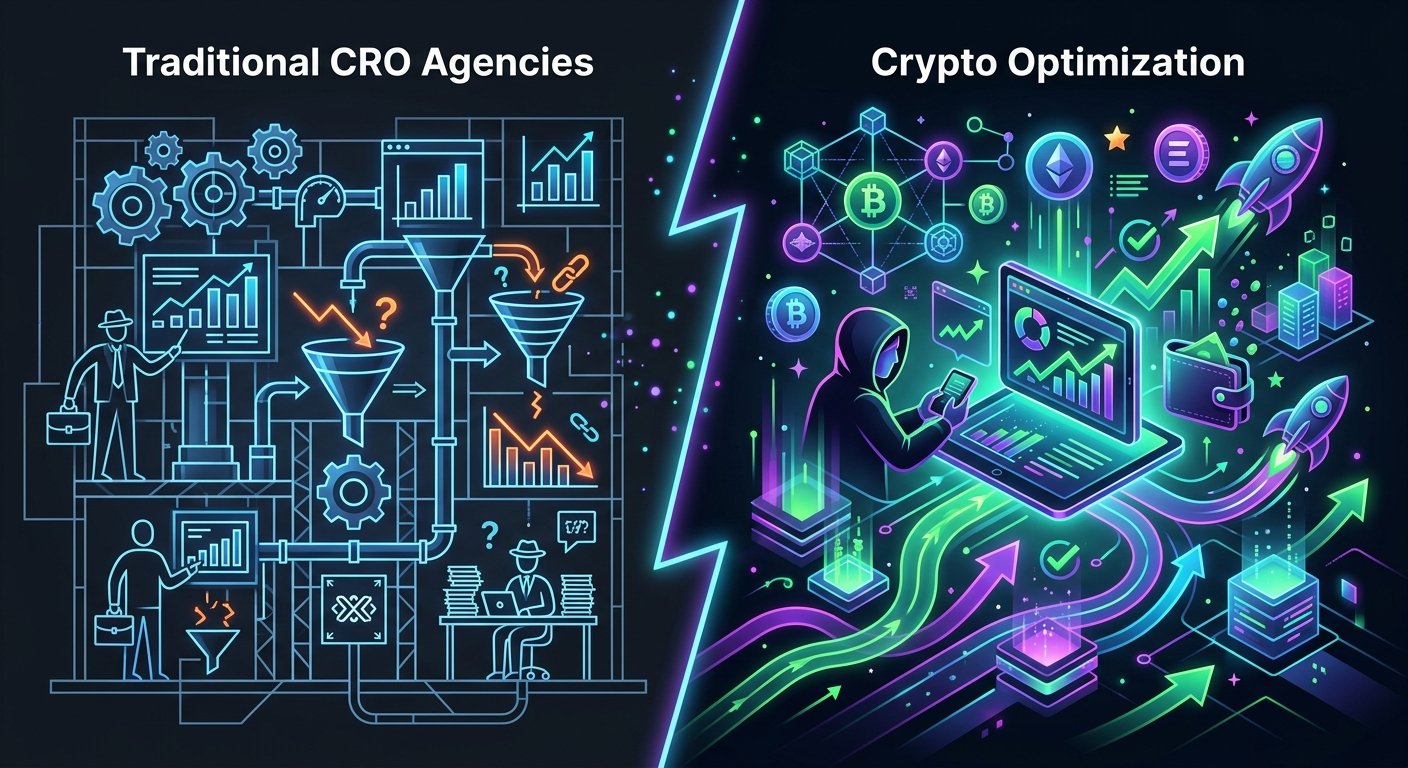
These are established conversion optimization firms that work primarily with e-commerce, SaaS, and lead generation businesses. They have proven frameworks, testing infrastructure, and statisticians on staff. Names like Conversion Rate Experts, Directive Consulting, or The Good fall into this category.
They promise data-driven optimization, rigorous testing methodology, and documented case studies showing 40-60% conversion lifts for clients.
Why Generic CRO Fails in Crypto
Here’s what most guides miss: traditional CRO agencies optimize for friction reduction. Their entire playbook assumes friction is bad. Remove form fields. Simplify the value proposition. Make checkout one-click.
In crypto, necessary friction signals legitimacy. A one-click “invest now” button on a DeFi protocol landing page doesn’t increase conversions; it triggers scam alerts. Visitors want to see the friction: audit reports, tokenomics documentation, team verification, legal disclaimers.
I’ve seen traditional agencies recommend removing the whitepaper link from above-the-fold because “it distracts from the CTA.” That guidance might work for Shopify stores. For crypto projects, hiding your whitepaper torpedoes trust instantly.
Where Traditional Agencies Add Value
That said, they’re excellent at the fundamentals: page speed optimization, mobile responsiveness, analytics implementation, multivariate testing infrastructure, and statistical analysis.
If your landing page loads in 6+ seconds, has broken wallet integration on mobile, or lacks proper event tracking, a traditional agency will fix those issues competently. They’ll implement heatmapping, session recording, and funnel analysis that you probably don’t have time to set up yourself.
The smart play: hire them to build your testing infrastructure and train your team, but don’t let them touch messaging, trust signals, or crypto-specific conversion elements without heavy supervision.
Pricing and Engagement Models
Retainer fees: $5,000-$15,000 per month for 20-40 hours of work. Project-based engagements: $15,000-$40,000 for a comprehensive audit plus 3 months of implementation.
Contracts typically run 6-12 months minimum. They’ll want 60-90 days just for research and hypothesis development before running actual tests.
Best for: Established crypto projects with 50,000+ monthly visitors, strong product-market fit, and technical leadership that can translate crypto requirements into CRO language. Not suitable for pre-launch or early-stage projects.
3. Web3-Native Growth Teams
These are agencies or consultants who specialize exclusively in crypto marketing and understand Web3 conversion psychology. A Best Crypto Marketing Agency like CryptoPromo, for example, focuses specifically on blockchain projects and understands wallet connection flows, tokenomics presentation, and trust signal optimization.
They combine growth marketing with crypto-specific conversion knowledge. They’ve optimized landing pages for token launches, NFT mints, DeFi protocols, and exchange listings.
The Web3 Optimization Framework
Web3-native teams use a different mental model. Instead of traditional funnel stages (Awareness, Interest, Desire, Action), they think in terms of the Crypto Trust Ladder:
- Pattern Recognition: Visitor scans for scam indicators in under 10 seconds
- Team Verification: Checks if founders are doxxed and have legitimate backgrounds
- Technical Validation: Reviews audit reports, GitHub activity, contract addresses
- Economic Assessment: Analyzes tokenomics, vesting schedules, utility
- Community Proof: Checks Telegram/Discord activity, Twitter engagement, holder distribution
- Conversion Action: Connects wallet, completes KYC, or makes commitment
Optimization happens at each rung. Instead of “make the CTA button bigger,” they ask “where in the trust ladder are visitors dropping off, and what signal would move them to the next rung?”
Practically, this means they’ll test things like:
- Audit badge placement and visibility (testing Certik vs Hacken vs multiple audits)
- Team section depth (photos + LinkedIn links vs full backgrounds vs video intros)
- Tokenomics presentation formats (tables vs infographics vs interactive calculators)
- Wallet connection friction (MetaMask priority vs WalletConnect vs email alternatives)
- Smart contract address display (prominent vs footer vs modal)
Real Platform and Tool Stack
Web3 growth teams use different analytics than traditional CRO agencies:
- Dune Analytics for tracking wallet connections and on-chain behavior
- Nansen or Arkham for analyzing who’s actually converting (whale wallets vs retail)
- Telegram/Discord analytics tools to track community referral conversions
- DeFiLlama for competitive benchmarking if you’re a protocol
- Standard tools like Google Analytics, Hotjar, and A/B testing platforms
They’ll also integrate with Web3-specific tools you’re already using: Snapshot for governance participation tracking, Zealy or Galxe for quest completion rates, or Coinvise for token-gated content access.
Cost and Commitment
Monthly retainers: $8,000-$25,000 depending on scope. Project-based: $20,000-$60,000 for comprehensive landing page optimization including strategy, design, development, and 3-6 months of testing.
Many Web3 agencies offer token payment options or hybrid models (partial USD, partial tokens) which traditional agencies won’t touch.
Timeline: 2-3 weeks for audit and strategy, 4-6 weeks for implementation, then 8-12 weeks of testing and iteration. Expect meaningful results in 3-4 months, not weeks.
Best for: Token projects raising $500K+, DeFi protocols with clear product-market fit, Layer 1/Layer 2 solutions needing user onboarding optimization, or any crypto project where wallet connection is the primary conversion goal.
4. In-House Data-Driven Teams
This is the “hire your own people” approach. You bring on a growth marketer, a data analyst, and maybe a conversion-focused designer or developer. They’re embedded full-time and own crypto landing page optimization as part of a broader growth mandate.
Companies like Uniswap, Aave, and Arbitrum use this model. They have dedicated growth teams running continuous experiments across their entire funnel.
Building Internal Capability
The team structure typically looks like:
- Growth Lead: $120K-$180K annually, owns strategy and experimentation roadmap
- Data Analyst: $90K-$140K annually, handles analytics, attribution, and experiment analysis
- Designer/Developer: $100K-$160K annually, implements variants and builds testing infrastructure
Total cost: $310K-$480K annually in salaries alone, plus tools, overhead, and benefits. You’re looking at $400K-$600K all-in for a basic in-house team.
That sounds expensive until you consider that a $20K/month agency retainer costs $240K annually and you don’t own the knowledge they build. After 2 years, the in-house team breaks even on cost while building institutional knowledge.
The Institutional Knowledge Advantage
In-house teams learn your product deeply. They understand your tokenomics, your community dynamics, your smart contract limitations, and your regulatory constraints. This context makes their optimization work far more sophisticated than external agencies who need briefings for every test.
They also move faster. No scope-of-work negotiations, no agency account manager bottlenecks, no monthly reporting decks. They can ideate a test on Monday and have it live by Friday.
The trade-off: they lack external perspective. They become blind to obvious issues because they’re too close to the product. They also miss cross-industry insights that agencies gain from working with 20+ clients simultaneously.
When In-House Makes Sense
You need serious scale to justify this. Minimum 100,000 monthly visitors to your landing pages, or 10,000+ monthly conversions of some kind (wallet connections, testnet signups, governance participation).
You also need organizational commitment to experimentation. If your CEO wants to approve every headline change, an in-house team will suffocate under bureaucracy. They need autonomy to run 15-20 tests per quarter without executive sign-off on each variant.
Best for: Well-funded protocols ($10M+ raised), established exchanges or platforms with significant traffic, or projects planning to stay in market for 5+ years where building internal capability pays off long-term.
5. Hybrid Template and Testing Models
This is the newest approach, popular among meme coin launches and fast-moving token projects. You start with battle-tested landing page templates specifically designed for crypto conversions, then layer on light optimization.
Companies like Webflow, Framer, and specialized crypto template marketplaces sell pre-built landing pages optimized for wallet connection flows, token sale countdowns, and audit badge placement. Prices range from $200-$2,000 for a template.
The Template-First Philosophy
Instead of building from scratch and then optimizing, you start with a design that already incorporates 50-100 conversion best practices learned from other crypto projects.
A good crypto landing page template will include:
- Pre-positioned trust signals (audit badges, team photos, security certifications)
- Tokenomics visualization components
- Wallet connection button patterns that work
- Mobile-optimized contract address display
- Countdown timer components for launches
- Social proof sections designed for crypto metrics (TVL, holders, volume)
You customize the content and branding, launch quickly, then run targeted tests on the 3-4 elements that matter most for your specific project.
Optimization Layer on Top
After launching the template, you focus testing on project-specific variables:
- Your unique value proposition messaging
- Tokenomics presentation (since every project’s economics differ)
- Community proof signals (which Telegram count, Twitter followers, or Discord members to highlight)
- Call-to-action specificity (generic “Join Now” vs “Connect Wallet to Claim Airdrop”)
This focused approach means you run 5-8 experiments instead of 50. You’re testing what’s unique to your project, not reinventing wallet connection UX patterns.
Real Numbers and Services
Template cost: $200-$2,000 one-time. Light optimization via freelancers or part-time contractors: $2,000-$8,000 monthly. Tools: $200-$400 monthly.
Total first-month cost: $2,400-$10,400. Ongoing monthly: $2,200-$8,400. This is 50-70% cheaper than agency work while delivering 70-80% of the results if you pick a proven template.
Timeline: 1-2 weeks from template purchase to launch. First round of optimization results in 4-6 weeks.
The catch: this only works if you pick templates that have actual crypto conversion data behind them. Many generic Webflow templates are just visually appealing; they haven’t been tested with real Web3 users. Look for templates from Meme Coin Marketing Agency specialists or designers who share conversion metrics.
Best for: Token launches with 4-8 week timelines, meme coins and community-driven projects, teams with design skills but no CRO expertise, or projects testing market fit before investing heavily in custom optimization.
Comprehensive Comparison Table
Here’s how the five approaches stack up across critical factors:
| Factor | Founder-Led | Traditional CRO | Web3-Native | In-House Team | Hybrid Template |
|---|---|---|---|---|---|
| Monthly Cost | $100-$400 tools | $5K-$15K retainer | $8K-$25K retainer | $35K-$50K salaries | $2K-$8K ongoing |
| Time to Results | 3-6 months | 4-6 months | 3-4 months | 2-3 months | 4-6 weeks |
| Web3 Expertise | Varies widely | Low to none | High specialized | Depends on hiring | Built into template |
| Minimum Traffic | Any level | 50K+ monthly | 5K+ monthly | 100K+ monthly | Any level |
| Control Level | Complete | Shared | Shared | Complete | High |
| Knowledge Retained | 100% internal | 10-20% transfer | 30-40% transfer | 100% internal | 60-70% retained |
Frequently Asked Questions
Which crypto landing page optimization approach works best for pre-launch token projects?
Hybrid template models or founder-led testing are your best options pre-launch. You don’t have enough traffic for statistical significance with agency testing, and you can’t justify in-house team costs before revenue. Start with a proven crypto template ($500-$2,000), customize it with your tokenomics and team info, then run founder-led tests on your unique value proposition messaging. This gets you to launch faster and costs under $5,000 total.
How much traffic do I need before hiring a Web3-native optimization agency?
Minimum 5,000 monthly visitors to your landing pages, ideally 10,000+. Below that threshold, A/B tests take too long to reach statistical significance and agencies can’t deliver ROI. The exception: if you’re driving highly qualified traffic from Twitter crypto influencers or community referrals and seeing conversion rates above 2-3%, an agency might optimize at lower volumes because the conversion value is high.
Can traditional CRO agencies handle DeFi protocol landing pages effectively?
Only with heavy supervision and crypto-literate leadership on your side. Traditional agencies excel at technical implementation, page speed, analytics setup, and testing infrastructure. But they’ll make dangerous mistakes on messaging, trust signal prioritization, and wallet integration flows unless you provide extremely detailed briefs. Better to use them for technical foundation work while keeping strategy in-house or with Web3 specialists.
Should I optimize for email signups or wallet connections as my primary conversion goal?
Wallet connections when possible, with one important caveat. Wallet connections indicate real user intent and let you track on-chain behavior through tools like Dune Analytics. Email signups are often low-quality in crypto because people use burner emails. However, if you’re in a highly regulated market or still in pre-launch phase, email might be your only legal option. In that case, optimize for “active email engagement” (opens, clicks) not just list size.
What conversion rate should I expect for a well-optimized crypto landing page?
It varies dramatically by traffic source and conversion type. Cold traffic from paid ads to wallet connection: 0.5-2% is typical. Warm traffic from community referrals or Crypto Influencers endorsements: 3-8%. Email signup conversions tend to run 2-5x higher than wallet connections because the commitment is lower. If you’re seeing under 0.3% on decent traffic, your landing page has serious trust or clarity issues that need addressing before running experiments.
📋 TL;DR Summary
- Founder-led testing works for early-stage projects under 5K monthly visitors, costs under $500/month, but risks local optimization traps without outside perspective.
- Traditional CRO agencies ($5K-$15K/month) excel at technical optimization but miss crypto-specific conversion psychology unless heavily managed.
- Web3-native teams ($8K-$25K/month) understand trust ladders and wallet friction but require 3-4 months and 5K+ traffic to deliver meaningful ROI.
- In-house teams ($35K-$50K/month) build institutional knowledge and move fastest but only justify costs at 100K+ monthly visitors.
- Hybrid template models ($2K-$8K/month) deliver 70-80% of agency results at half the cost by starting with proven patterns then testing project-specific elements.
- Choose based on traffic volume, budget, timeline, and whether you need to build long-term capability or ship quickly.
Conclusion
Crypto landing page optimization isn’t about choosing the “best” approach in absolute terms. It’s about matching the method to your project stage, traffic volume, budget reality, and timeline constraints.
If you’re pre-launch or under 5,000 monthly visitors, start with a hybrid template model or founder-led testing. You don’t have the volume to justify agency costs, and you need to move quickly. Get a battle-tested crypto template, customize it for your project, and run targeted tests on your unique value proposition.
Between 5,000 and 50,000 monthly visitors with $50K+ marketing budget, Web3-native agencies deliver the best results. They understand the crypto trust ladder, they’ve optimized wallet flows dozens of times, and they bring cross-project insights you can’t build internally yet.
Above 100,000 monthly visitors with serious funding, build an in-house team. The institutional knowledge and speed advantages outweigh the higher costs, and you’ll retain all the testing insights for your next product launches.
What actually matters is understanding that crypto conversion psychology differs fundamentally from e-commerce or SaaS. Trust signals matter more than design polish. Wallet connection friction is unavoidable, not a bug to eliminate. Community referrals convert 4-8x better than cold traffic. Optimize around these realities, not generic CRO playbooks.
The projects that win aren’t running the most A/B tests. They’re running the right tests, on the elements that actually move crypto users from skepticism to commitment. Start there, regardless of which approach you choose.
If you need specialized help with crypto landing page optimization that understands Web3 conversion psychology, wallet integration challenges, and trust signal placement, CryptoPromo works with projects at every stage to build landing pages that convert cold visitors into committed community members. From comprehensive optimization to crypto marketing strategy development, we focus on the unique challenges blockchain projects face. Get a quote to discuss your specific optimization needs.


