

Last updated: May 2026
Your DeFi protocol just secured $3M in funding. The smart contracts are audited. The tokenomics look solid. But three weeks after launch, your Telegram has 47 members and your Twitter engagement is flatlined at 0.3%. Meanwhile, a meme coin with zero utility just did 40x because they understood something you didn’t about how crypto marketing actually works right now.
The crypto marketing trends insights that separate successful launches from ghost chains have nothing to do with traditional marketing playbooks. According to CoinDesk, over 70% of token launches fail to maintain community engagement past the first month, not because of product issues but because they’re using outdated marketing approaches that stopped working in 2023.
Business strategy research from Harvard Business Review emphasizes that successful marketing in emerging industries requires understanding the unique communication patterns and trust signals specific to that ecosystem. In crypto, those patterns change every quarter. What worked during the last bull run gets you ignored today.
This guide cuts through the surface-level advice you’ll find on generic Crypto Blogs to deliver actionable crypto marketing trends insights based on what’s actually performing across hundreds of Web3 campaigns. You’ll learn why community-first beats hype-first, how to time your marketing around invisible market cycles, and which metrics actually predict long-term success.
What You Need to Know About Today’s Crypto Marketing Environment

Before diving into specific trends, you need to understand the fundamental shift that’s happened in how crypto projects gain traction. The environment today punishes projects that treat marketing as a launch event rather than an ongoing conversation.
The old model looked like this: build product, create hype, launch with big announcements, hope for viral growth. The new model recognizes that crypto audiences are sophisticated, burned by hundreds of failed projects, and scanning for authenticity signals before they invest attention or capital.
Research from Cointelegraph analyzing successful 2025 launches shows that projects with consistent pre-launch community building (4-6 months minimum) achieved 3-4x higher first-month retention compared to projects that rushed to market with aggressive paid campaigns.
The competitive landscape has also intensified. Every day brings 50+ new token launches on platforms like Pump Fun alone. Your marketing needs to cut through noise levels that would make traditional CMOs quit on day one.
Here’s what separates projects that gain real traction: they understand that crypto marketing trends insights aren’t about following influencer playbooks. They’re about building systems that create genuine believers who stick around when the price action goes sideways.
1. Community-First Marketing Outperforms Hype-First Every Time
Problem: Most crypto projects treat community building as a box to check. They spin up a Discord, post generic memes on Twitter, and wonder why engagement dies after the initial launch pump. The symptom is clear: 5,000 Discord members but only 12 people talking. Twitter followers don’t convert to holders. Nobody shows up to AMAs.
Solution: Flip the script entirely. Community-first marketing means building genuine relationships before you need them, creating value before asking for attention, and treating early supporters like partners rather than exit liquidity.
In practice, this looks radically different from traditional crypto marketing. Instead of announcing your project with a big splash, you start conversations in existing communities where your target users already gather. You contribute value without shilling. You identify 20-30 genuine believers and give them early access, equity, or advisory roles.
One Layer 2 scaling solution launched in early 2025 using this approach. They spent six months active in developer communities, contributing to GitHub discussions, and hosting technical workshops before they even announced their chain. By launch day, they had 200 developers who felt ownership in the project’s success. Those 200 developers brought their networks, creating organic growth that paid marketing could never replicate.
The Framework for Community-First Marketing breaks down into three phases:
Phase 1: Identify and Infiltrate (Months 1-2)
Find where your ideal users already congregate. This isn’t about joining every crypto Discord. It’s about finding the 3-5 communities where your specific target audience actively discusses problems your project solves. For DeFi protocols, that might be Yearn Finance or Curve forums. For infrastructure projects, it’s developer Discords and GitHub.
Contribute value without mentioning your project. Answer questions. Share insights. Build credibility as an expert, not a marketer. Track usernames of people who engage with your contributions.
Phase 2: Create Your Core (Months 3-4)
Reach out individually to 20-30 people you identified in Phase 1. Share your project privately. Ask for brutal feedback. Offer early access, advisory positions, or token allocations in exchange for ongoing input. These people become your core team, advocating before launch because they helped shape the product.
This is where most projects fail. They skip the hard work of individual outreach and jump to broadcasting. Individual conversations don’t scale, which is exactly why they work. Each core community member brings 5-10 people from their network when you launch.
Phase 3: Enable Advocacy (Months 5-6)
Give your core community tools to spread the word on their terms. Create content they can remix. Provide talking points, not scripts. Set up referral systems that reward genuine sharing, not bot farms.
The difference between this approach and traditional marketing shows up in retention metrics. Projects using community-first strategies typically see 60-70% of first-month users still active after six months, compared to 10-15% for hype-first launches.
Working with a Best Crypto Marketing Agency that understands community dynamics can accelerate this process, but only if they’re willing to do the unglamorous work of actual relationship building rather than just running ad campaigns.
2. Market Cycle Timing Matters More Than Message Quality
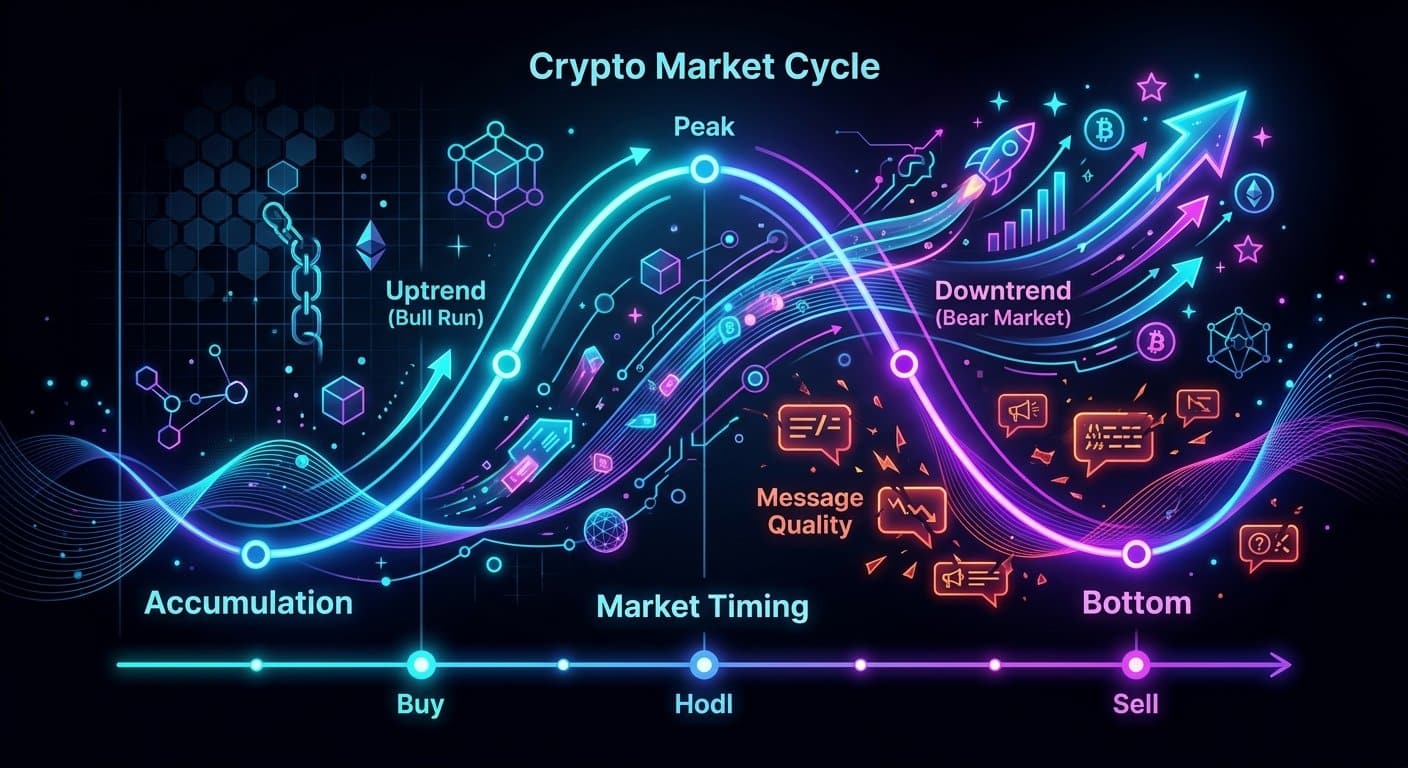
Problem: Projects pour resources into perfect messaging, beautiful websites, and polished videos, then launch at exactly the wrong moment in the market cycle. They watch their carefully crafted campaign disappear into a bear market news cycle where nobody’s paying attention to new launches. Or worse, they launch during a bull market top when every project looks like a winner and differentiation is impossible.
Solution: Master the art of timing your marketing pushes around micro and macro market cycles. The best message delivered at the wrong time produces zero results. A decent message delivered when your audience is actively looking produces exponential returns.
Understanding crypto marketing trends insights means recognizing that crypto operates on multiple overlapping cycles that traditional markets don’t have. There’s the four-year halving cycle everyone knows about. But there are also quarterly cycles driven by options expiry, weekly cycles around weekend trading patterns, and even daily cycles where attention shifts between US and Asian trading hours.
Most projects only think about macro timing (bull vs bear). Smart projects optimize for micro timing within whatever macro environment they’re in. Here’s what that looks like:
The Weekly Pattern
Crypto Twitter engagement peaks Tuesday through Thursday, US time zones. Weekend engagement drops 40-50% as casual traders check out. But Telegram and Discord activity spikes Sunday evenings as people plan their week’s trades. Schedule major announcements for Tuesday or Wednesday mornings. Save community AMAs for Sunday evening when your most engaged users are online.
The Monthly Options Cycle
Major options expiry dates (last Friday of each month) create volatility that drowns out project news. Avoid major launches or announcements in the three days around monthly expiry. The week after expiry typically sees calmer markets and higher receptivity to new project news.
The Narrative Cycle
This is the big one most projects miss. Crypto moves through narrative phases where certain categories of projects get disproportionate attention. In early 2025, the narrative was restaking protocols. By mid-2025, attention shifted to consumer crypto apps. Launching a DeFi protocol during a consumer app narrative phase means fighting for scraps of attention.
Track narrative cycles by monitoring what Twitter crypto influencers and Youtube Crypto Influencers are covering. When 5+ major accounts start discussing a category within the same week, that narrative is heating up. If your project fits that narrative, accelerate your marketing timeline. If it doesn’t, either wait or pivot your messaging to connect to the current narrative.
One exchange token launch in late 2025 demonstrates this perfectly. They had planned a September launch but noticed narrative attention shifting toward exchange tokens in October based on influencer discussion volume and trading volume metrics. They delayed launch by three weeks, rode the narrative wave, and achieved 5x better first-week performance than their initial projections suggested.
Building a Timing Dashboard
Create a simple tracking system for timing signals:
- Weekly: Monitor crypto Twitter engagement rates on your test posts
- Monthly: Track major options expiry dates (available on any crypto derivatives platform)
- Quarterly: Watch for shifts in narrative focus across major influencer channels
- Yearly: Understand where you are in the halving cycle
Perfect execution at the wrong time beats mediocre execution at the right time exactly never. But good execution at precisely the right moment creates results that look like magic to everyone watching.
3. True Engagement Metrics Predict Success While Vanity Metrics Lie
Problem: Projects celebrate hitting 10,000 Twitter followers while their actual holder count stays at 200. Discord servers show 5,000 members but only 20 people talked last week. These vanity metrics create an illusion of success that masks the actual problem: nobody’s engaged enough to hold through volatility or tell their friends about your project.
Solution: Shift focus entirely to true engagement metrics that actually correlate with project success. Stop measuring follower counts and start measuring conversation depth, holder retention through drawdowns, and organic mention rates.
The crypto marketing trends insights that separate sophisticated projects from amateurs live in understanding which metrics matter. After analyzing hundreds of launches, the pattern is clear: follower counts have zero correlation with price performance or project longevity. Engagement depth has nearly perfect correlation.
Here are the metrics that actually predict success:
The 10% Active Rule
In any crypto community, 10% of members drive 90% of engagement. Your key metric isn’t total Discord members, it’s how many people participated in discussions in the last seven days divided by total members. Healthy communities maintain 8-12% seven-day active rates. Below 5% means you have a ghost town with bots and lurkers.
Track this weekly in a spreadsheet: Active Members (last 7 days) / Total Members = Active Rate. When this number drops below 6%, you have an engagement crisis brewing before it shows up in other metrics.
Holder Retention Through Drawdowns
This is the ultimate test of community strength. When your token price drops 30% in a week (and it will), what percentage of holders from the previous week are still holding? Projects with genuine communities see 70-80% retention through 30% drawdowns. Projects with mercenary communities see 30-40% retention.
You can track this using on-chain analytics tools like Dune Analytics. Create a dashboard showing weekly holder counts and overlay price action. The pattern reveals your actual community strength.
Organic Mention Rate
How often do people mention your project without tagging your official accounts? This is nearly impossible to fake and highly correlated with long-term success. Use social listening tools to track mentions of your project name or ticker across Twitter, Discord, and Telegram that don’t include your official account tags.
Projects with strong organic mention rates (10+ unprompted mentions per day for every 1,000 community members) have built something people genuinely want to talk about. Projects with low organic mention rates are paying for attention that evaporates the moment they stop paying.
Response Time and Quality
How fast do community members answer new user questions? This metric reveals whether you’ve built a community or just an audience. In healthy communities, new questions get answered within 10-15 minutes by community members (not mods or team) with helpful, detailed responses.
Track average response time to new user questions weekly. When this metric deteriorates, your engaged core is shrinking even if total member counts are growing.
Building Your Real Metrics Dashboard
Stop using vanity dashboards that make you feel good. Build a metrics dashboard that shows uncomfortable truth:
- Seven-day active rate (target: >8%)
- Holder retention through 20% drawdowns (target: >70%)
- Daily organic mentions per 1,000 members (target: >10)
- Average response time to new questions (target: <20 minutes)
- Percentage of holders active in community channels (target: >25%)
When these metrics trend positive, your project has genuine momentum regardless of what follower counts say. When they trend negative, you have problems that can’t be solved with more paid advertising.
A Crypto Marketing Strategy built around true engagement metrics produces sustainable growth. One built around vanity metrics produces temporary spikes followed by inevitable crashes.
4. Content Distribution Channels Have Completely Flipped
Problem: Projects still allocate marketing budgets like it’s 2021: heavy on Twitter ads, light on everything else. They assume Twitter is still the center of crypto conversation while missing that attention has fragmented across channels with completely different audience behaviors. Their content strategy produces Twitter threads nobody reads while ignoring Telegram channels where actual community building happens.
Solution: Completely rethink channel allocation based on where crypto audiences actually spend time now and what behaviors each channel drives. The crypto marketing trends insights around channel effectiveness have shifted dramatically in the past 18 months.
Twitter is still important, but it’s become a discovery and credibility channel rather than a conversion channel. People discover projects on Twitter, but they evaluate legitimacy and make decisions elsewhere. Understanding this distinction changes everything about how you use each platform.
The New Channel Hierarchy
Based on campaign data across multiple Web3 projects, content distribution effectiveness now follows this rough hierarchy for most token launches:
Tier 1: Telegram (Community Building)
Telegram has become the primary venue for serious crypto communities. Daily active engagement rates in Telegram groups run 3-5x higher than Discord for most projects. The threading structure and mobile-first design match how crypto traders actually work.
Allocate 40-50% of your community management resources to Telegram. Post daily updates, create discussion threads around market events, and foster peer-to-peer help. The groups that work share alpha, trading strategies, and project updates in roughly equal measure.
Tier 2: Twitter (Discovery and Credibility)
Twitter drives discovery but rarely drives immediate conversion. Your Twitter strategy should focus on thought leadership, credibility signals, and broad reach rather than direct selling. Allocate 25-30% of content resources here.
The most effective Twitter approach now: thread breakdowns of complex topics related to your project space, regular engagement with other quality projects, and consistent presence without constant shilling. Projects that tweet 4-6 times daily with 80% value content and 20% project updates massively outperform those that only tweet announcements.
Tier 3: Discord (Technical Support and Deeper Engagement)
Discord works best for projects with complex technical components that need structured documentation and support channels. Developer-focused projects still see strong Discord engagement. Community-focused projects often find Discord becomes a ghost town while Telegram thrives.
If you maintain Discord, allocate 15-20% of resources and structure it around specific use cases: developer support, governance discussions, or organized subgroups. General chat channels in Discord tend to die while focused channels stay active.
Tier 4: YouTube and Podcasts (Authority Building)
Long-form content has made a comeback as audiences seek signal in a noise-saturated environment. Getting featured on crypto podcasts or creating detailed YouTube explainers builds authority that can’t be faked. Allocate 10-15% of resources to creating or facilitating long-form content.
One DeFi protocol gained more qualified users from a single 45-minute podcast appearance than from three months of Twitter advertising. The difference: podcast listeners self-select for depth and are further along the evaluation journey.
Content Format That Works by Channel
Each channel demands different content approaches:
Telegram thrives on: Quick market updates, community polls, AMA sessions, alpha sharing, peer discussions
Twitter works for: Threads explaining complex concepts, industry commentary, engaging with other projects, selective announcements
Discord succeeds with: Structured documentation, technical support, governance proposals, organized working groups
YouTube and podcasts excel at: Deep dives into technology, founder interviews, educational series, industry analysis
The mistake most projects make is creating the same content for every channel. A Twitter thread reformatted for Telegram gets ignored. A Telegram discussion exported to Twitter loses context. Channel-specific content takes more work but produces exponentially better results.
Working with specialists like a Meme Coin Marketing Agency for community-driven projects or a Crypto PR Agency for media relationships ensures you’re optimizing for each channel’s unique dynamics rather than treating all channels the same.
5. Paid Advertising Requires Surgical Precision Not Spray and Pray
Problem: Projects burn through $50K-$200K in paid advertising budgets chasing impressions and clicks that never convert to holders or community members. They run broad Twitter campaigns targeting “crypto enthusiasts” or buy bot-filled Telegram members, then wonder why none of these users stick around or contribute. The money disappears while community size stays flat.
Solution: Treat paid advertising as a precision instrument for reaching specific audience segments at specific moments, not a megaphone for broadcasting to everyone. The era of spray-and-pray crypto advertising is over. Sophisticated targeting and ruthless optimization separate effective campaigns from money pits.
The fundamental shift in crypto marketing trends insights around paid advertising: audiences have become incredibly sophisticated at filtering out low-quality ads. The same ad that might have driven signups in 2023 gets scrolled past in seconds now. You need better targeting, better creative, and better timing.
The Targeting Precision Framework
Instead of targeting broad audiences, build micro-segments based on behavior:
Segment 1: Active DeFi Users (High Intent)
Target people who have interacted with specific DeFi protocols in the past 30 days. Use platforms like Twitter ads with custom audiences built from wallet addresses (where privacy allows) or target followers of specific DeFi protocols that complement yours. These users have demonstrated actual usage behavior, not just interest.
Typical acquisition cost: $25-$75 per qualified user who joins your community
Segment 2: Crypto Twitter Engagers (Medium Intent)
Target users who regularly engage with (not just follow) specific crypto thought leaders and projects similar to yours. Someone who comments on Vitalik’s tweets or regularly replies in certain project threads is more valuable than someone who just follows generic crypto accounts.
Typical acquisition cost: $15-$40 per community join
Segment 3: Crypto-Curious (Low Intent, High Volume)
Broader targeting of people interested in crypto generally. Only use this for top-of-funnel awareness, never for direct conversion campaigns. These audiences need 6-10 touchpoints before they’re ready to engage meaningfully.
Typical acquisition cost: $5-$15 per impression/awareness, rarely converts directly
Creative That Cuts Through
The creative approach that works now looks nothing like traditional crypto ads. Forget laser eyes and rocket emojis. The ads that perform:
Problem-Solution Format: Start with a specific problem your target user faces. “Tired of paying $50 in gas fees for simple swaps?” Then show your solution. This outperforms hype-based creative by 3-4x in conversion rates.
Proof Over Promises: Show on-chain data, audits, or real user testimonials rather than making aspirational claims. A screenshot showing actual transaction costs or TVL performs better than claims about being “revolutionary.”
Native Format: Ads that look like native content (threads, discussions, educational posts) outperform ads that look like ads. The best performing Twitter ad campaigns look like valuable threads that happen to mention the project naturally.
Platform-Specific Strategies
Each advertising platform requires different approaches:
Twitter Ads: Use for retargeting people who visited your site but didn’t convert, and for reaching followers of complementary projects. Avoid broad “crypto” targeting. Run 7-10 day campaigns timed around narrative cycles. Creative should be thread-style educational content.
Budget range: $5K-$15K for targeted campaign reaching 50K-100K qualified impressions
Google Ads: Limited by crypto ad restrictions, but can work for educational content and comparison keywords. Target people searching for specific competitor names or protocol types. Landing pages must comply with strict Google policies around crypto content.
Budget range: $3K-$10K monthly for search campaigns
Crypto-Native Platforms: Platforms like CoinGecko, CoinMarketCap, and crypto news sites offer display ads reaching highly qualified audiences. These typically have better intent than social platforms since users are actively researching.
Budget range: $10K-$30K for prominent placements
The Testing and Optimization Cycle
Treat every paid campaign as a test with clear success metrics defined upfront:
- Test 3-5 different audience segments simultaneously with small budgets ($500-$1,000 each)
- Measure cost per qualified action (community join, wallet connect, meaningful engagement) not just clicks
- Kill underperforming segments after 5-7 days
- Scale winning segments gradually, watching for quality degradation as you scale
- Rotate creative every 10-14 days to avoid ad fatigue
The projects that make paid advertising work profitably test relentlessly and kill losers fast. The projects that burn money keep running the same underperforming campaigns hoping they’ll eventually work.
If you’re struggling to make paid advertising profitable, getting a Crypto Marketing Quote from specialists can help you understand whether your targeting, creative, or timing needs adjustment.
Should You Invest in Paid Crypto Advertising?
✅ YES if:
- You have at least $10K monthly budget to test properly
- Your landing pages and conversion funnels are already optimized
- You can measure and track conversions accurately
- You have resources to test multiple segments and creative variations
- Your organic channels are already performing well
❌ NO if:
- You’re trying to fix poor product-market fit with advertising
- Your budget is under $5K monthly (insufficient for meaningful testing)
- You can’t dedicate time to daily optimization and monitoring
- Your website or community infrastructure isn’t ready for traffic
- You haven’t validated messaging with organic content first
| Channel | Best Use Case | Typical CPM | Quality Score |
|---|---|---|---|
| Twitter Ads | Discovery, retargeting | $15-$35 | Medium to High |
| Crypto News Sites | Brand awareness, credibility | $25-$60 | High |
| Google Search | Competitor targeting, education | $8-$25 | High |
| Telegram Ads | Direct community building | $10-$30 | Variable (high bot risk) |
| Influencer Sponsorships | Trust building, reach | $30-$150 | Depends on influencer |
Recommended Budget Allocation for $25K Monthly Marketing Spend
35%
25%
20%
15%
5%
📋 TL;DR Summary
- Community-first marketing outperforms hype-first every time. Build genuine relationships with 20-30 core believers before broadcasting to thousands. Projects using this approach see 60-70% retention versus 10-15% for traditional launches.
- Market cycle timing matters more than message quality. The best content at the wrong time produces zero results. Master weekly patterns, monthly options cycles, and quarterly narrative shifts to maximize impact.
- True engagement metrics predict success while vanity metrics lie. Track seven-day active rates (target 8%+), holder retention through drawdowns (target 70%+), and organic mention rates (target 10+ per 1,000 members) instead of follower counts.
- Distribution channels have flipped with Telegram now driving more community engagement than Discord or Twitter for most projects. Allocate resources based on where your specific audience actually congregates and what behaviors each channel drives.
- Paid advertising requires surgical precision not spray and pray. Target micro-segments based on behavior, test ruthlessly, and kill underperforming campaigns fast. Budget minimum $10K monthly for meaningful testing.
Frequently Asked Questions
Which crypto marketing agency is best for DeFi protocol launches?
The best agency depends on your specific protocol type and target audience. For DeFi protocols, look for agencies with demonstrated experience in technical community building and developer relations, not just hype generation. A Best Web3 Marketing Agency should be able to show case studies of protocols they’ve launched with sustained TVL growth, not just initial pump metrics. Ask for retention numbers 90 days post-launch and what percentage of initial users remained active.
How much should a new token project budget for marketing in the first six months?
Based on successful launches across different project types, expect to budget $50K-$150K for the first six months depending on your goals. Break this down roughly as: 35% on community management and engagement, 25% on content creation, 20% on targeted paid advertising testing, 15% on PR and influencer relationships, and 5% on tools and analytics. Projects that skimp on the community management portion consistently underperform regardless of how much they spend on advertising.
What’s the realistic timeline from starting marketing to having an engaged community ready for launch?
Count on 4-6 months minimum if you’re building genuine community from scratch. Month 1-2: infiltrate existing communities and build credibility. Month 3-4: recruit and activate your core 20-30 believers. Month 5-6: enable advocacy and scale community growth. Projects that rush this timeline launch to hollow communities that disappear after initial hype. The exception is if you’re launching from an existing project with an established community, which can compress timelines to 6-8 weeks.
Should we focus on Twitter or Telegram as our primary community channel?
For most token projects, Telegram drives higher engagement and better holder retention while Twitter drives discovery and credibility. The answer isn’t choosing one, it’s understanding what each channel does well. Use Twitter for thought leadership, industry engagement, and broad reach. Use Telegram for daily community engagement, alpha sharing, and building the core holder community. Projects that treat Twitter as their only community channel consistently underperform in retention metrics compared to projects that invest equally in Telegram community management.
How do we measure if our marketing is actually working before token launch?
Track leading indicators that predict launch success: your seven-day active rate in pre-launch community channels should be above 10%, your core members should be bringing their networks organically (track referral sources), and you should be seeing unprompted mentions of your project in other communities or channels. If your waitlist or whitelist is growing linearly with paid advertising but stalls when you pause ads, you don’t have organic momentum yet. Real traction shows continued growth during periods when you’re not actively promoting.
Conclusion
The crypto marketing trends insights that separate successful projects from the thousands that launch to silence aren’t secret. They’re just uncomfortable because they require patience, precision, and a willingness to measure truth rather than celebrate vanity metrics.
Most projects fail at marketing not because they lack budget or creativity, but because they’re optimizing for the wrong things. They chase follower counts instead of engagement depth. They spray advertising across broad audiences instead of targeting surgical segments. They launch at the wrong moment in market cycles because they’re impatient. They measure success by how impressive their metrics look in screenshots rather than how many genuine believers they’ve created.
The pattern across hundreds of successful launches is consistent: community-first beats hype-first. Timing beats perfect messaging. True engagement predicts success while vanity metrics predict disappointment. Channel-specific strategies outperform cross-posting. Precision advertising works while spray-and-pray burns money.
Implementing these crypto marketing trends insights requires discipline most projects don’t have. Building genuine community for six months before launch feels excruciatingly slow when you see meme coins pumping daily. Killing underperforming ad campaigns after a week feels wasteful when you’ve put work into creating them. Focusing on 8% active rates instead of total member counts feels unimpressive in pitch decks.
But the numbers don’t lie. Projects that implement these approaches consistently outperform by 3-5x in the metrics that actually matter: holder retention, community engagement, and long-term sustainability.
If you’re launching a crypto project and want help implementing these strategies without the trial-and-error learning curve, Contact CryptoPromo to discuss how we approach Web3 marketing differently than agencies still running 2021 playbooks. We focus on building genuine communities that stick around, not creating impressive screenshots that evaporate after launch.
Meowifhat’s token launch exceeded its initial goal by over 37x, raising 3,733 SOL against a 100 SOL target through strategic community engagement and meme-driven content that tapped into Solana’s vibrant cat coin narrative. This case demonstrates a key 2024 trend: successful crypto campaigns now prioritize authentic community building and cultural relevance over traditional advertising spend, with projects that align with existing blockchain subcultures seeing dramatically higher conversion rates. The campaign’s performance validates the shift toward narrative-led marketing, where understanding platform-specific culture drives measurable results.
Filled Successfully 3,733 SOL / 100 SOL


