

Last updated: May 2026
You’ve spent months building your protocol. The smart contracts are audited. Your tokenomics model is bulletproof. Launch date is set for 6 weeks out. Then you open Twitter and see a competitor with worse tech raise $3M in 48 hours while your waitlist has 200 subscribers.
The brutal reality? Technical excellence doesn’t guarantee launch success. I’ve watched teams with innovative DeFi protocols fail to hit their modest $500K targets while meme coins with zero utility clear $10M. The difference isn’t the product, it’s the marketing strategy executed in the 8-12 weeks before token generation.
This token launch marketing guide walks through 12 specific strategies that separate successful launches from quiet failures. No generic advice about “building community” or “creating content.” Instead, you’ll get tactical frameworks with budget ranges, timeline specifics, and the mistakes that kill 70% of token launches before they start.
According to Forbes crypto industry coverage, marketing spend now represents 15-25% of total raise allocation for serious Web3 projects. That’s not wasteful, it’s strategic. The projects treating marketing as an afterthought are the ones struggling to maintain liquidity 90 days post-launch.
What You Need Before Starting Your Token Launch
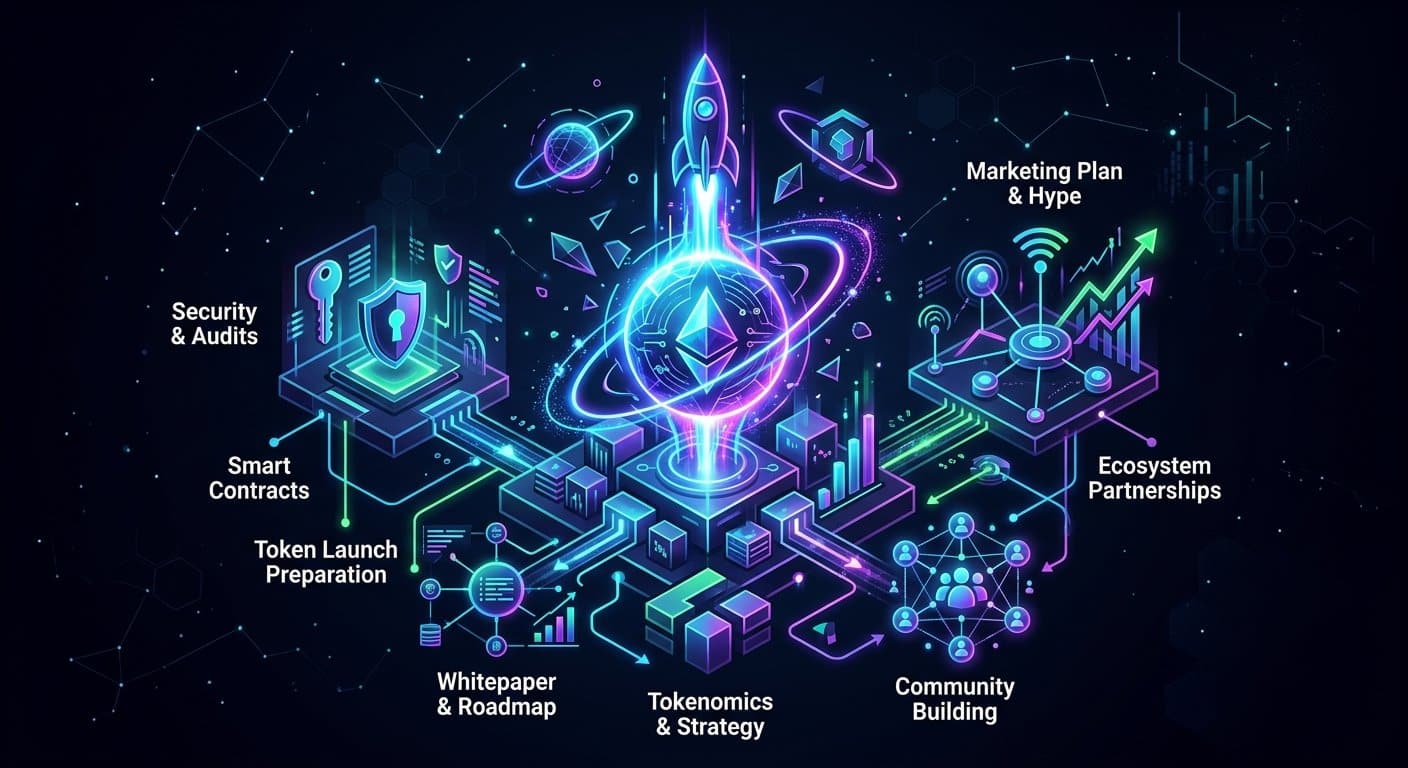
Most founders jump into marketing tactics without the foundational assets in place. You cannot run an effective campaign without these prerequisites locked down first.
Your token economics must be finalized and publicly documented. Investors won’t commit without understanding supply schedules, vesting periods, and allocation breakdowns. Create a one-page tokenomics summary that answers: total supply, circulating at launch, team allocation with vesting terms, and utility mechanisms. Pin this to your social channels.
Legal structure matters more than founders want to admit. Operating without proper entity formation or regulatory consideration creates friction during exchange listings and partnership discussions. At minimum, establish a foundation in crypto-friendly jurisdictions and document your compliance approach even if you’re pursuing a decentralized launch.
Your core narrative needs to be battle-tested before you spend a dollar on marketing. Can you explain your project’s value proposition in one sentence? Test this with 10 people outside crypto. If they can’t repeat it back accurately, your messaging isn’t ready for paid distribution.
The Pre-Launch Asset Checklist
Here’s what you need ready before executing any marketing strategy in this token launch marketing guide:
- Website with clear value proposition, tokenomics page, roadmap, and team section
- Whitepaper or litepaper (8-15 pages maximum, not a 50-page academic paper)
- Brand assets: logo variations, color palette, social media templates
- Core messaging document: mission statement, positioning, key differentiators
- Community guidelines and moderation structure for Telegram and Discord
- Media kit with founder bios, high-res images, and boilerplate description
1. Map Your Token Launch Timeline
Problem: Most projects start marketing 2-3 weeks before token generation. By then, it’s too late to build the awareness and trust required for a strong launch. You end up scrambling, overpaying for last-minute influencer posts, and launching to a cold audience.
Solution: Work backwards from your target launch date using a 12-week marketing calendar. This gives you enough time to build organic momentum while strategically layering paid tactics.
The proven timeline structure breaks into four phases: Foundation (weeks 1-4), Acceleration (weeks 5-8), Pre-Launch (weeks 9-11), and Launch Week (week 12). Each phase has specific deliverables and success metrics.
Foundation Phase focuses on community infrastructure and content creation. Launch your Telegram and Discord. Post daily on Twitter with educational content about your sector, not just promotion. Goal: 500-1,000 engaged community members who understand your value proposition.
Acceleration Phase introduces paid tactics. Start working with micro-influencers, publish guest posts on crypto media sites, and begin partnerships with complementary projects. Goal: 2,500-5,000 community members with 5-10% daily active engagement.
Pre-Launch Phase is your maximum effort period. Announce partnerships, release major product updates, secure top-tier media coverage, and activate all influencer relationships simultaneously. Goal: 10,000+ community members, social proof through media mentions, and a waitlist 3-5x your minimum viable launch size.
Launch Week executes your coordinated push across all channels. This isn’t when you start marketing, it’s when you convert the audience you’ve spent 11 weeks building.
| Phase | Duration | Primary Focus | Success Metric |
|---|---|---|---|
| Foundation | Weeks 1-4 | Community building, content creation | 500-1,000 members |
| Acceleration | Weeks 5-8 | Paid tactics, influencer seeding | 2,500-5,000 members |
| Pre-Launch | Weeks 9-11 | Maximum visibility push | 10,000+ members |
| Launch Week | Week 12 | Conversion and activation | 20-30% participation rate |
2. Build Your Community Infrastructure First

Problem: Projects create Telegram and Discord channels, pin some links, and call it community infrastructure. Then they wonder why engagement dies within a week. Empty channels with sporadic founder posts create the perception of a ghost project.
Solution: Treat community infrastructure like product development. Design channel structures that encourage specific behaviors, implement moderation systems that scale, and create content calendars that maintain daily activity without burning out your team.
For Telegram, start with a single announcement channel and one discussion group. Don’t create 12 channels for different languages and topics when you have 200 members. Launch with: one announcement channel (admin-only posting), one main discussion group, and clear rules pinned in both. Add topic-specific channels only after hitting 2,000+ members with sustained engagement.
Discord requires more upfront structure because users expect organized channels. Minimum viable Discord setup: welcome and rules channel, general discussion, token discussion, technical support, and off-topic. Use roles to segment contributors, investors, and community members. Implement slow mode on main channels to prevent spam.
The pattern across successful projects: daily activity from team members, weekly AMAs or community calls, and rewards for quality contributions. Gamification works. Projects using systems like Zealy or Galxe for community quests report 40-60% higher engagement during launch periods.
Community Management That Scales
You cannot personally moderate growing communities while managing launch execution. Identify 3-5 active early community members and grant them moderator status by week 3. Provide clear guidelines, compensation in tokens, and decision-making authority for common situations.
Create a moderation playbook covering: how to handle FUD, when to ban vs warn users, approved response templates for common questions, and escalation procedures for your core team. This document prevents inconsistent enforcement and protects your brand.
Use bots strategically. Welcome bots, auto-moderation for spam patterns, and FAQ responders reduce manual work. But over-automation kills community feel. Balance is posting important updates manually while automating repetitive tasks.
3. Execute Strategic Influencer Partnerships
Problem: Projects browse influencer lists, DM 50 crypto YouTubers asking for promotional videos, and get ignored or quoted $25K for a single mention. When they do get placements, the results disappoint because the influencer’s audience doesn’t align with their project type or the content feels like obvious promotion.
Solution: Build influencer relationships in tiers, starting with genuine product engagement before discussing paid promotions. The most effective influencer campaigns combine organic advocacy, strategic paid placements, and co-created content that provides real value to audiences.
Start with micro-influencers (5,000-50,000 followers) who actively cover your specific sector. A DeFi lending protocol should target influencers discussing yield strategies, not general crypto news personalities. Research their content quality, audience engagement rates, and past project promotions before outreach.
For YouTube crypto influencers, expect pricing of $1,000-$5,000 for channels under 100K subscribers, $5,000-$15,000 for 100K-500K, and $15,000-$50,000+ for top-tier channels. But don’t lead with payment. Send personalized messages explaining why your project aligns with their content thesis. Offer early access, exclusive interviews with founders, or co-created educational content before discussing sponsored mentions.
Twitter remains the primary channel for crypto launches. Twitter crypto influencers typically charge $500-$3,000 per thread for accounts with 50K-200K followers, assuming 2-4% engagement rates. Package deals covering announcement day plus 2-3 follow-up posts perform better than single-shot promotions.
The Three-Tier Influencer Framework
Tier 1 (Micro, 5K-50K followers): Use for early awareness and authentic reviews. Budget $500-$2,000 per influencer. Goal: 10-15 micro-influencers posting throughout your Acceleration Phase. These create social proof and content you can repurpose.
Tier 2 (Mid, 50K-250K followers): Use for targeted reach during Pre-Launch Phase. Budget $2,000-$8,000 per influencer. Goal: 3-5 mid-tier influencers with highly engaged audiences in your specific niche. Quality over quantity matters here.
Tier 3 (Macro, 250K+ followers): Use sparingly for maximum impact during Launch Week. Budget $10,000-$50,000+ per influencer. Goal: 1-2 macro influencers as credibility signals. Their mention validates your project for smaller influencers and media outlets.
4. Secure Strategic Media Coverage
Problem: Founders write generic press releases, blast them to 500 journalists via paid distribution services, and receive zero coverage. Or they pay $5,000-$15,000 for guaranteed publication on crypto news sites that generate no meaningful traffic or community growth.
Solution: Treat media relations as relationship building, not transactional promotion. Focus on earning coverage through newsworthy angles, exclusive access, and journalist-friendly packaging rather than paying for placements that audiences immediately recognize as advertisements.
The media landscape has tiers. Top-tier outlets (CoinDesk, The Block, Decrypt, Cointelegraph) rarely cover token launches unless you have significant differentiation, notable backers, or exclusive data. Mid-tier crypto publications and sector-specific outlets provide more accessible opportunities for emerging projects.
According to Investopedia’s cryptocurrency research, projects receiving coverage in at least three recognized crypto publications within their launch week see measurably better initial trading volume than those relying solely on social media promotion.
Create story angles beyond “we launched a token.” Journalists need newsworthy hooks. Strong angles include: novel technical innovations with third-party validation, partnerships with recognized names, exclusive data or research findings, contrarian perspectives on industry trends, or founder stories that humanize your project.
Package your story for journalist convenience. Provide a one-paragraph summary, three key bullet points, relevant statistics with sources, high-res images, and founder availability for interviews. Make their job easier and response rates improve significantly.
Working with a crypto PR agency makes sense when you need established media relationships and strategic narrative development. Agencies with proven journalist connections can secure placements that independent outreach cannot. Expect retainers of $8,000-$25,000 per month for legitimate PR firms with crypto specialization.
PR Timeline and Pitching Strategy
Start media outreach 6-8 weeks before launch, not 1 week before. Journalists need time to evaluate stories, conduct interviews, and fit you into editorial calendars. Pitch exclusive stories to top-tier outlets first, offering them first-mover advantage in exchange for timing their coverage to your launch window.
Personalize every pitch. Reference the journalist’s recent articles, explain why your story fits their beat, and provide the specific angle. Generic mass emails get deleted. Targeted pitches to 10-15 carefully selected journalists outperform blast campaigns to 500 random contacts.
Follow up strategically. One follow-up email 3-4 days after initial outreach is professional. Multiple daily follow-ups are spam. If a journalist says no or doesn’t respond after one follow-up, move on and maintain the relationship for future opportunities.
5. Design a Content Engine That Builds Authority
Problem: Projects post randomly on social media with no content strategy. One day it’s a meme, next day a technical deep-dive, then nothing for a week. Followers don’t know what to expect and engagement flatlines. Content feels reactive rather than strategic.
Solution: Build a systematic content calendar that balances education, community engagement, and promotional content across a 60/30/10 split. Educational content establishes expertise, community content builds relationships, and promotional content drives conversions.
Your content engine runs on three core content types across three primary channels. For Twitter: daily educational threads, project updates twice weekly, and community engagement through replies and quote tweets. For Telegram: daily discussion prompts, weekly AMAs, and announcement posts for major updates. For Discord: daily team presence in channels, weekly voice chats, and organized community events.
Educational content demonstrates expertise without selling. If you’re launching a DeFi lending protocol, create content explaining yield optimization strategies, smart contract risk assessment, or comparing different lending models. You’re teaching your target audience while positioning your solution as the logical choice.
The pattern across successful token launches: 3-4 months of consistent high-quality content before asking for anything. Projects that start with “buy our token” messaging before establishing expertise struggle. Those that spend months educating their audience launch to pre-sold communities.
The 60/30/10 Content Distribution Formula
Allocate 60% of content to pure education and value. These posts teach concepts, share data, provide frameworks, or analyze trends with zero mention of your project. Build intellectual authority first. Examples: Twitter threads breaking down tokenomics models, blog posts analyzing competitor approaches, or Discord workshops on technical topics.
Allocate 30% to community building and engagement. These posts create conversation, celebrate milestones, showcase community contributions, or provide behind-the-scenes access. Examples: polls asking community input on features, spotlighting active community members, or founder Q&As addressing specific questions.
Allocate just 10% to direct promotion. These posts explicitly ask for action like joining your whitelist, participating in your token sale, or sharing your content. The constraint is intentional. When 90% of your content provides value without asking for anything, your 10% promotional content performs significantly better.
6. Structure Your Token Sale Mechanics for Marketing Success
Problem: Projects design their token sale structure purely from financial and legal perspectives, ignoring how sale mechanics impact marketing effectiveness. Complicated participation processes, unclear eligibility requirements, and poor user experience create friction that kills conversion even when marketing builds awareness.
Solution: Design your token sale structure with marketing and user experience as primary considerations. Every decision, from whitelist requirements to vesting schedules, impacts your ability to attract and convert participants. Simple, transparent, and accessible mechanics outperform complex structures even when the latter seems more sophisticated.
Choose your sale format based on your audience and marketing capacity. Public sales on DEXs require massive awareness and immediate liquidity but offer maximum accessibility. Private sales to strategic investors provide capital with lower marketing requirements but limited community participation. Launchpad sales through platforms like DAO Maker or TrustSwap provide marketing support and credibility but surrender control and pay significant fees.
According to CoinMarketCap’s launchpad analysis, projects using established launchpads typically access 50,000-200,000 potential participants but pay 5-15% of raise plus token allocations to the platform. The trade-off: built-in audience versus platform fees and control limitations.
Whitelist mechanics significantly impact marketing. Simple email-based whitelists convert 40-60% of interested users. Multi-step KYC processes with document submission drop conversion to 10-20%. Token-gated whitelists requiring holdings of specific assets limit your addressable market but create exclusivity that can drive FOMO.
Marketing-Optimized Sale Structure
Create tiers that reward different participant types. Early supporters who completed whitelist tasks get favorable allocation or pricing. Community members who contributed content or referrals receive bonus allocations. Strategic advisors and partners access private terms. This structure provides marketing hooks at every level.
Gamify the whitelist process to build engagement. Projects using quest platforms like Zealy or Galxe for whitelist qualification report 3-5x higher social media engagement during their pre-launch period compared to passive email collection. Tasks can include following social channels, creating content, referring others, or participating in community activities.
Make participation dead simple. The fewer steps between “interested user” and “token holder,” the higher your conversion. If your process requires downloading MetaMask, acquiring specific tokens, connecting to a new chain, navigating a complex interface, and submitting KYC documents, you’ll lose 70-80% of interested participants to friction.
7. Allocate Your Marketing Budget Strategically
Problem: Projects either wildly overspend on ineffective tactics or severely underfund marketing entirely. Common mistakes include spending $50,000 on a single top-tier influencer while having no budget for community building, or allocating $200,000 to marketing but spreading it across 30 different tactics with no focus.
Solution: Structure your marketing budget using a proven allocation framework that balances organic community building with strategic paid tactics. For most token launches, total marketing spend should represent 15-25% of your target raise or 8-12% of total initial token allocation value.
A project raising $2M should allocate $300,000-$500,000 to marketing. That’s not excessive, it’s strategic. Projects that cheap out on marketing and allocate $50,000 while expecting million-dollar raises consistently underperform. The math is simple: if marketing delivers a 3-5x return on investment (measured in raise amount or initial market cap), underspending costs more than overspending.
Recommended Budget Allocation
Community building and content (30%) covers community managers, content creators, designers, and ongoing engagement programs. This is your foundation. Skimping here to fund flashy influencer posts is backwards.
Influencer marketing (25%) funds your tiered influencer strategy across micro, mid-tier, and macro influencers. Spread this across your 12-week timeline rather than blowing it all in launch week.
PR and media relations (20%) pays for agency retainers, press release distribution, media monitoring tools, and journalist relationship building. Quality PR takes time and consistent investment.
Paid advertising (15%) covers targeted campaigns on Twitter, Google Display, crypto-specific ad networks, and sponsored content placements. Use this to amplify organic efforts, not replace them.
Tools and contingency (10%) covers marketing software subscriptions, analytics platforms, emergency response budget, and unexpected opportunities. Always maintain a buffer for market timing opportunities.
Budget Scaling by Project Size
Small projects (under $500K raise target): $40,000-$75,000 total marketing budget. Focus on community building and micro-influencers. Skip expensive PR agencies and top-tier influencers. Maximize founder time and organic efforts.
Medium projects ($500K-$2M raise target): $75,000-$300,000 total marketing budget. Add mid-tier influencers, work with specialized PR agencies, and implement paid advertising. This is where professional marketing support becomes necessary.
Large projects ($2M+ raise target): $300,000-$1M+ total marketing budget. Execute comprehensive strategies across all channels, engage top-tier influencers and media, consider partnerships with established crypto marketing agencies for campaign coordination. At this scale, in-house execution alone becomes insufficient.
8. Coordinate Multi-Channel Launch Day Execution
Problem: Launch day arrives and projects execute randomly. An influencer post goes live at 3am when your community is asleep. Your PR placement publishes after token sale ends. Discord mods don’t know how to answer basic questions. The result: wasted marketing spend and confused potential participants.
Solution: Build a minute-by-minute launch day runbook coordinating every marketing activity across all channels and time zones. Every team member, partner, and influencer operates from the same timeline with clear responsibilities and communication protocols.
Your launch day actually spans 48-72 hours if you’re executing properly. Pre-launch phase (12-24 hours before), main launch window (official token generation event), and post-launch momentum (24-48 hours after). Each phase has specific objectives and coordinated activities.
Pre-launch phase builds anticipation without revealing exact timing. Influencers post “final reminders” content, community team seeds excitement in channels, PR placements go live with embargo lifting at launch time, and paid advertising campaigns activate targeting users who engaged with previous content.
Main launch window is your maximum coordination moment. Within a 2-4 hour period: official announcement across all owned channels, influencer posts go live simultaneously, community team executes coordinated engagement, founders conduct live AMAs, and every channel points users to clear participation instructions.
The Launch Day Timeline Template
T-24 hours: Pre-launch content from influencers goes live. Community team activates “final countdown” messaging. All systems and links tested multiple times. Support team briefed on common questions.
T-2 hours: All team members online and ready. Final coordination call with all partners confirms everyone understands timing. Backup communication channels established in case primary channels fail.
T-0 (Launch): Official announcement posted simultaneously across Twitter, Telegram, Discord, website. Email blast to waitlist. Influencer content activates. Paid campaigns go live. Founders available for immediate engagement.
T+2 hours: First metrics review. Community team shares early traction signals in channels. Quick-response content created based on questions or confusion patterns emerging.
T+8 hours: Mid-launch check-in. Adjust messaging based on what’s working. Address any technical issues or confusion. Amplify positive signals and testimonials.
T+24 hours: Post-launch momentum push. Share results, celebrate milestones, spotlight early participants, and maintain visibility while your project trends.
9. Implement Performance Tracking and Attribution
Problem: Projects run marketing campaigns without proper tracking, then can’t determine what worked. They spent $100,000 across 15 tactics but have no idea if influencers, PR, paid ads, or organic community drove results. Post-launch, they either blindly repeat the same strategy or randomly change everything based on gut feel.
Solution: Build attribution systems from day one that track every marketing dollar to specific outcomes. Use unique tracking links, campaign codes, and post-event surveys to understand which channels and tactics delivered returns versus which wasted budget.
For every influencer partnership, provide unique referral links or campaign codes. Track not just clicks but downstream actions: Telegram joins, Discord members, whitelist signups, and token purchases. An influencer with 500K followers who drives 50 whitelist signups performs worse than one with 50K who drives 200 signups.
Implement UTM parameters on all external links. Structure them consistently: utm_source (platform), utm_medium (content type), utm_campaign (specific initiative), utm_content (creative variation). This data flows into Google Analytics or your analytics platform, showing exactly which promotional efforts drive traffic and conversions.
For community sources, use Discord/Telegram join links specific to each traffic source. Create separate invite links for: influencer A, influencer B, paid Twitter ads, PR article, etc. Most platforms provide analytics showing how many users joined via each link.
Key Metrics to Track Throughout Your Token Launch Marketing Campaign
Awareness metrics: Twitter impressions and follower growth, media mentions and estimated reach, Discord/Telegram member growth rate, website traffic and unique visitors. These show top-of-funnel performance.
Engagement metrics: Social media engagement rate (likes/comments/shares per post), Discord daily active users percentage, Telegram message volume, content performance (which topics resonate), community sentiment through social listening. These indicate message resonance.
Conversion metrics: Whitelist conversion rate (visitors to signups), cost per whitelist signup, participation rate (whitelist to actual token purchase), total raise amount, average contribution size. These measure bottom-line effectiveness.
Create a simple dashboard showing these metrics daily during your 12-week launch period. Google Sheets works fine. The point isn’t sophisticated analytics, it’s consistent visibility into what’s working so you can adjust tactics mid-campaign.
10. Build Strategic Partnerships That Amplify Reach
Problem: Projects approach partnerships as networking opportunities or vague collaboration agreements. They announce partnerships with other early-stage projects that have equally small audiences, creating announcements that generate zero incremental reach. Or they pursue partnerships with large players who have no incentive to actively promote a small project.
Solution: Structure partnerships as explicit audience-sharing or co-marketing agreements with clear deliverables and mutual benefit. Target partners who have the audience you need and to whom you can provide genuine value, creating win-win arrangements that both parties actively promote.
The best partnership targets sit one tier above you in project maturity. If you’re launching, partner with projects that launched 6-12 months ago and have established communities of 10,000-50,000 members. They remember being in your position and gain credibility by supporting emerging projects. You gain access to their audience.
Structure partnership terms explicitly. “We’ll promote your upcoming feature to our community in exchange for you announcing our launch to your Discord.” Create co-marketing campaigns where both projects benefit. Joint AMAs, collaborative content pieces, shared airdrops, or integrated product features work better than announcement-only partnerships.
Crypto-native partnership opportunities include: protocol integrations (if you’re DeFi), chain partnerships (if you’re launching on specific L1/L2), wallet integrations, data provider collaborations, or ecosystem partnerships. Each comes with potential co-marketing opportunities.
Partnership Pitch Framework
Lead with specific value. Don’t pitch “let’s partner” generically. Pitch “we’ll create a custom yield strategy using your protocol and produce three educational threads explaining it to our 15,000 followers, generating you awareness in the lending community.” Specificity gets responses.
Offer first. Most partnership requests ask for something without offering value. Reverse this. Offer to feature them in your launch announcement, create content highlighting their solution, or integrate their technology, then ask for reciprocal promotion. Leading with value creates goodwill.
Focus on complementary audiences. Partner with projects targeting the same user type through different solutions. A DeFi lending protocol should partner with yield aggregators, portfolio trackers, or DeFi education platforms. All serve the same audience with non-competing offerings.
11. Manage Community Expectations and Handle Launch Volatility
Problem: Token launches create extreme emotional volatility in communities. Price pumps create euphoria and unrealistic expectations. Price dumps create panic and accusations of rug pulls. Community channels devolve into chaos with conflicting information, spreading FUD, and team members providing inconsistent responses.
Solution: Set clear expectations about post-launch volatility before it happens, establish communication protocols for your team, and maintain consistent transparent messaging regardless of price action. Your marketing doesn’t end at launch, it transitions to community management and expectation setting.
Pre-launch, explicitly address volatility expectations. Post content explaining: “Launch day will see significant price volatility. This is normal. Our focus is building long-term value, not optimizing for day-one price.” Set this expectation repeatedly during your pre-launch period so it’s not a surprise.
Create response templates for common post-launch scenarios: price drops, technical issues, exchange listing questions, tokenomics concerns, and timeline questions. Every team member and moderator uses the same language, preventing conflicting information that erodes trust.
Maintain regular communication cadence post-launch. Daily updates for the first week, then shift to twice-weekly updates, then weekly as things stabilize. Consistent communication prevents information voids that FUD fills. Even if you have no major news, update the community on operational activities.
The Post-Launch Communication Framework
Day 1-3: Multiple updates per day. Share metrics, address common questions, spotlight positive community content, and maintain visible founder presence. Community needs constant reassurance during highest uncertainty period.
Week 1: Daily updates transitioning from multiple times daily to once per day. Begin establishing normal communication rhythm while still maintaining elevated presence.
Week 2-4: Twice-weekly structured updates. Establish regular update schedule (example: Monday and Thursday). Community begins expecting and relying on these regular touchpoints.
Month 2+: Weekly updates minimum. Transition to milestone-based announcements supplemented by regular weekly check-ins. Community has stabilized and excessive updates become noise.
12. Plan Your Post-Launch Marketing Strategy
Problem: Projects treat token launch as the finish line for marketing. They exhaust their budgets and energy on launch week, then go quiet for months while expecting their token to maintain momentum. Community activity drops 70-80% within three weeks. Price follows community sentiment downward.
Solution: Build a post-launch marketing plan before launch that maintains visibility, sustains community engagement, and delivers on roadmap promises. Successful projects allocate 40% of their first-year marketing budget to post-launch activities, not just the launch event.
Post-launch marketing has different objectives than pre-launch. You’re no longer building awareness or driving initial participation. You’re maintaining engagement, onboarding new users, demonstrating progress, and building long-term brand presence. The tactics shift accordingly.
Content focus shifts from promotional to educational and progress-oriented. Replace “join our launch” messaging with “here’s what we shipped this week” and “here’s how to use our protocol effectively.” Create user success stories, integration announcements, partnership reveals, and roadmap progress updates.
Community engagement programs become critical. Launch ambassador programs, create content creator funds, reward quality contributors, and build systems for community governance or input. Projects maintaining active communities 6 months post-launch nearly always outperform those with declining community metrics.
The 90-Day Post-Launch Timeline
Days 1-30: Maintain elevated marketing presence. Execute your prepared post-launch content, announce early wins, spotlight community contributions, and deliver quick wins from roadmap. Goal: prevent immediate momentum loss.
Days 31-60: Transition to sustainable rhythm. Establish regular content cadence, implement community programs, begin longer-term partnership activations, and demonstrate consistent progress. Goal: prove you’re building, not just launching.
Days 61-90: Expand visibility efforts. Re-engage influencers with progress updates, pursue media coverage of milestones achieved, explore new marketing channels, and assess what’s working to refine strategy. Goal: reach audiences who missed initial launch.
Most successful Web3 projects maintain monthly marketing spend of 15-25% of their launch period monthly spend indefinitely. If you spent $300,000 over 12 weeks pre-launch (approximately $100,000 per month), plan for ongoing marketing budget of $15,000-$25,000 per month minimum. Projects that cut marketing to near-zero post-launch consistently struggle.
📋 TL;DR Summary
- Start your token launch marketing 12 weeks before launch, not 2 weeks. The Foundation, Acceleration, Pre-Launch, and Launch phases each serve specific purposes that cannot be compressed.
- Allocate 15-25% of your target raise to marketing budget. Distribute this across community building (30%), influencer marketing (25%), PR (20%), paid advertising (15%), and contingency (10%).
- Build influencer relationships in tiers: micro-influencers for authentic early awareness, mid-tier for targeted reach, and macro for credibility signals only during launch week.
- Design your token sale mechanics with marketing in mind. Simple, accessible participation processes convert 3-4x better than complex multi-step requirements.
- Track attribution for every marketing dollar spent. Use unique links, campaign codes, and clear metrics to understand ROI by channel and tactic.
- Plan post-launch marketing before launch. Maintain 15-25% of launch-period monthly marketing spend indefinitely to sustain momentum and community engagement.
Frequently Asked Questions
How much should I budget for token launch marketing if I’m raising $1M?
For a $1M target raise, allocate $150,000-$250,000 to marketing (15-25% of target). Distribute this as: $45,000-$75,000 for community building and content, $37,500-$62,500 for influencer marketing, $30,000-$50,000 for PR and media relations, $22,500-$37,500 for paid advertising, and $15,000-$25,000 for tools and contingency. Projects that allocate less than 15% consistently underperform their raise targets. Those spending more than 30% often see diminishing returns unless they have differentiated strategies.
What is the minimum timeline needed for effective token launch marketing?
Eight weeks minimum, twelve weeks optimal. Compressed timelines force you to rely heavily on paid tactics without building organic community foundation. Projects attempting 4-week launch campaigns typically overspend on last-minute influencer posts while lacking the community infrastructure to convert awareness into participation. If you have less than 8 weeks, delay your launch to execute properly or dramatically lower your raise expectations.
Should I work with a crypto marketing agency or build an in-house team?
For projects raising under $500K, in-house execution with strategic contractors makes sense. For projects raising $500K-$2M, hybrid approaches work best: in-house community management plus specialized agency support for PR and influencer relations. For projects above $2M, partnering with a best crypto marketing agency provides coordination capacity and established relationships that in-house teams cannot replicate quickly. Agency costs range from $15,000-$50,000+ per month depending on scope and project complexity.
How do I measure if my token launch marketing was successful?
Success metrics depend on your objectives but typically include: achieving 80%+ of your target raise amount, maintaining 20-30% participation rate from whitelist to actual purchase, building a community of 10,000+ engaged members by launch, securing coverage in at least 3-5 recognized crypto publications, and sustaining community engagement above 5% daily active rate in the 30 days post-launch. Cost efficiency matters too: track cost per whitelist signup (target: $10-$50) and marketing spend as percentage of total raise (target: 15-25%).
What are the biggest mistakes projects make in token launch marketing?
The top five fatal mistakes: starting marketing too late (less than 4 weeks before launch), underfunding marketing relative to raise target, focusing exclusively on paid tactics without organic community building, failing to track attribution and ROI by channel, and going dark post-launch instead of maintaining marketing presence. Projects making any two of these mistakes rarely hit their raise targets. Those making three or more almost always fail.
Conclusion
Token launches don’t succeed because of superior technology or innovative tokenomics. They succeed because of strategic marketing executed consistently over 8-12 weeks across multiple channels with clear attribution and community focus.
This token launch marketing guide covered 12 essential strategies, from timeline mapping and community infrastructure to influencer coordination and post-launch planning. But reading strategies doesn’t execute campaigns. Implementation separates projects that hit their targets from those that quietly fade.
The common thread across successful launches: they started early, invested appropriately, tracked performance rigorously, and maintained consistency through launch volatility. Your technical innovation deserves a marketing strategy of equal sophistication.
Projects investing 15-25% of their target raise in strategic marketing consistently outperform those treating marketing as an afterthought. The question isn’t whether to invest in launch marketing, it’s whether to do it strategically with proven frameworks or randomly with hope-based budgets.
If you’re planning a token launch in the next 6 months and need strategic support executing these frameworks, CryptoPromo specializes in comprehensive token launch campaigns for Web3 projects. Our team has coordinated launches across DeFi protocols, Layer 1 blockchains, and emerging crypto projects. Get a crypto marketing quote to discuss your specific launch timeline and marketing requirements.
Book Of Games exceeded their presale target by 272%, filling 136 SOL when they had initially aimed for just 50 SOL. This dramatic oversubscription demonstrates how a strategic token launch campaign can tap into genuine market demand and create momentum that carries far beyond initial projections. Their success came from implementing a phased community-building approach that turned early supporters into active promoters during the critical launch window.
Filled Successfully 136 SOL / 50 SOL


