

Last updated: May 2026
Your IDO whitelist opens in 96 hours. You’ve got a Discord server with 800 members, half of whom joined from a single influencer post three weeks ago and haven’t spoken since. Your Telegram channel has 1,200 people, but when you ask questions, maybe six respond. Your Twitter following sits at 4,500, but engagement hovers around 0.8%. You’ve spent $12,000 on various marketing efforts, yet when you look at your whitelist registrations, you’re seeing maybe 150 qualified submissions.
This is the reality for most startups attempting their first token sale. The gap between what founders think IDO marketing services for startups should deliver and what actually drives capital commitment is massive. According to Investopedia’s analysis of token launches, the majority of projects that fail to reach their funding targets share one common pattern: they confuse awareness metrics with investment conviction.
Strategic marketing research from McKinsey demonstrates that in emerging markets, including digital assets, the customer acquisition journey requires an average of 7-12 touchpoints before conversion. For crypto projects, where investors are risking capital in speculative assets, that number often exceeds 15 touchpoints. Most startups approach IDO marketing services with a spray-and-pray mentality, buying isolated tactics without understanding this fundamental conversion architecture.
After working across dozens of token launches, the pattern is clear: projects that raise meaningful capital during their IDO don’t just market harder, they market smarter. They understand that IDO marketing services for startups must address specific investor concerns at each stage of consideration. Let’s dismantle the most damaging myths that cause startups to waste their marketing budgets.
What You Need to Know Before Hiring IDO Marketing Services
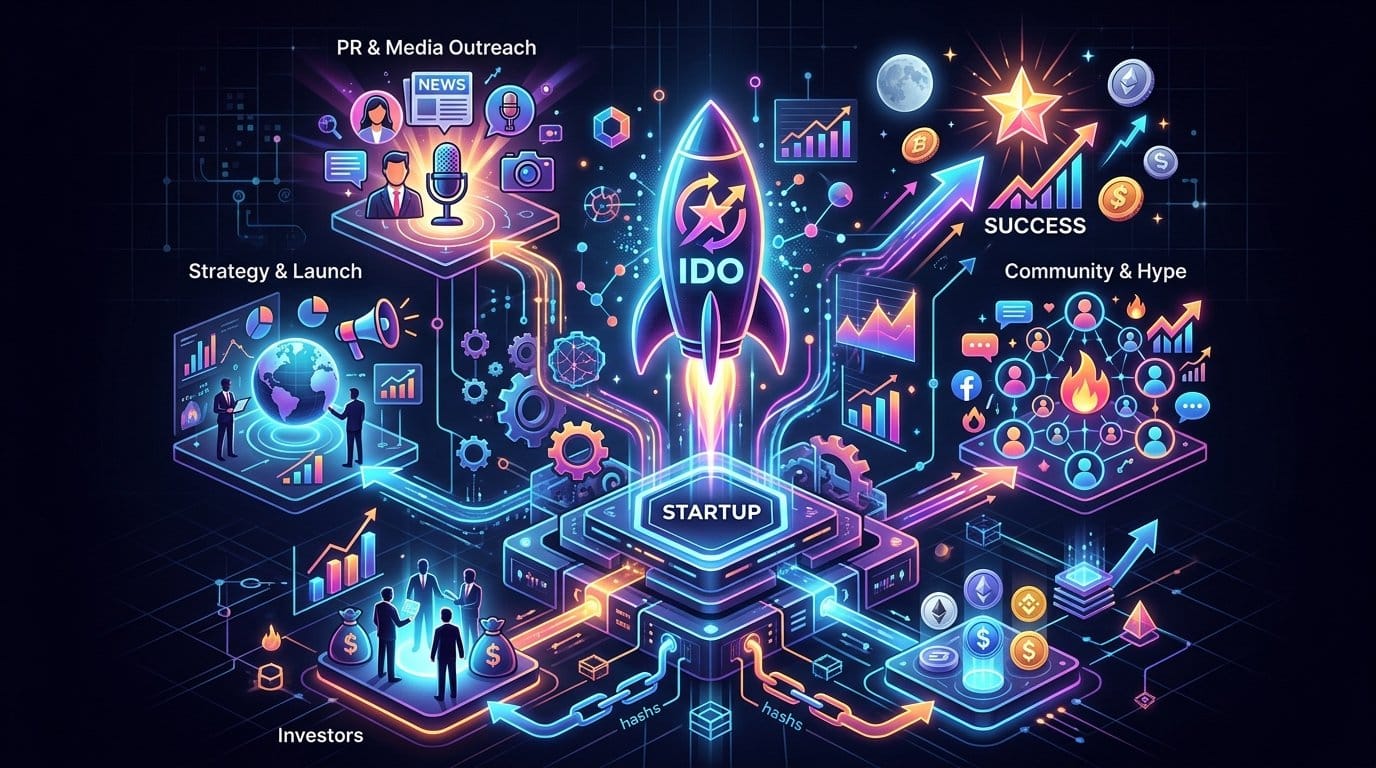
Before diving into specific myths, understand that the IDO landscape has matured significantly since the 2020-2021 boom cycle. Investors have become more sophisticated, scam awareness is higher, and the competition for attention has intensified. Your startup needs to approach IDO marketing services with realistic expectations grounded in current market conditions.
The average marketing budget for a startup IDO ranges from $25,000 to $150,000, depending on fundraising targets and timeline. Projects aiming to raise under $500K typically allocate $25K-$50K to marketing. Those targeting $1M-$3M raises often spend $75K-$150K. According to CoinMarketCap’s IDO planning guide, proper budget allocation across channels significantly impacts both raise amounts and post-launch token performance.
Most critically, effective IDO marketing starts 6-10 weeks before your actual token sale. Projects that begin marketing two weeks before their IDO consistently underperform. The timeline matters because building genuine community engagement and establishing credibility signals cannot be rushed without appearing manipulative or fake.
Myth 1: More Followers Automatically Mean More Investors
The Misconception: Startups often believe that accumulating large follower counts across social platforms directly translates to IDO participation. Many founders measure marketing success by how quickly they hit 5,000 Twitter followers or 2,000 Discord members, assuming these numbers will convert into whitelist registrations and token purchases.
Reality: Follower count is one of the least reliable predictors of actual investment. In practice, projects with 3,000 highly engaged, niche-targeted followers consistently outperform those with 15,000 low-quality followers acquired through aggressive follow-for-follow tactics or bot services.
The metric that matters is engagement depth. When you post an update about your tokenomics, how many people ask substantive questions? When you share technical development progress, who comments with informed feedback? These interactions signal genuine interest from potential investors who understand your project and see investment opportunity.
Research from multiple Web3 projects shows that conversion rates from social followers to actual IDO participants range between 2-8% for organic, engaged communities, versus 0.1-0.5% for purchased or low-quality followers. A startup with 2,000 genuinely interested followers might see 80-160 whitelist conversions. One with 10,000 disengaged followers might see 10-50.
What Engagement Quality Actually Looks Like
Real engagement appears as multi-message conversations, not single-emoji reactions. In Discord, quality shows up as members helping each other understand your documentation, debating technical implementation choices, or organizing community initiatives without prompting from your team. In Telegram, it’s the difference between a channel where you broadcast to silence versus one where members share your updates to their networks unprompted.
Twitter engagement quality can be measured by reply depth. Do people write 2-3 sentence responses to your threads, or just drop generic “great project” comments? The former signals actual interest, the latter indicates bot-like behavior or mercenary engagement farmers.
The Hidden Cost of Vanity Metrics
Chasing follower counts creates another problem: algorithm penalties. Twitter, Discord, and Telegram all use engagement-based algorithms to determine content visibility. When you have 10,000 followers but only 50 actually engage with your content, platforms interpret your content as low-quality and reduce its organic reach. You end up paying more for paid promotion to reach even your existing followers.
From campaign data across multiple Web3 projects, accounts with smaller but highly engaged followings achieve 3-5x better organic reach per post compared to accounts with inflated follower counts and poor engagement rates. This compounds during your IDO marketing push when organic amplification matters most.
Myth 2: IDO Marketing Services for Startups Are Just Influencer Campaigns
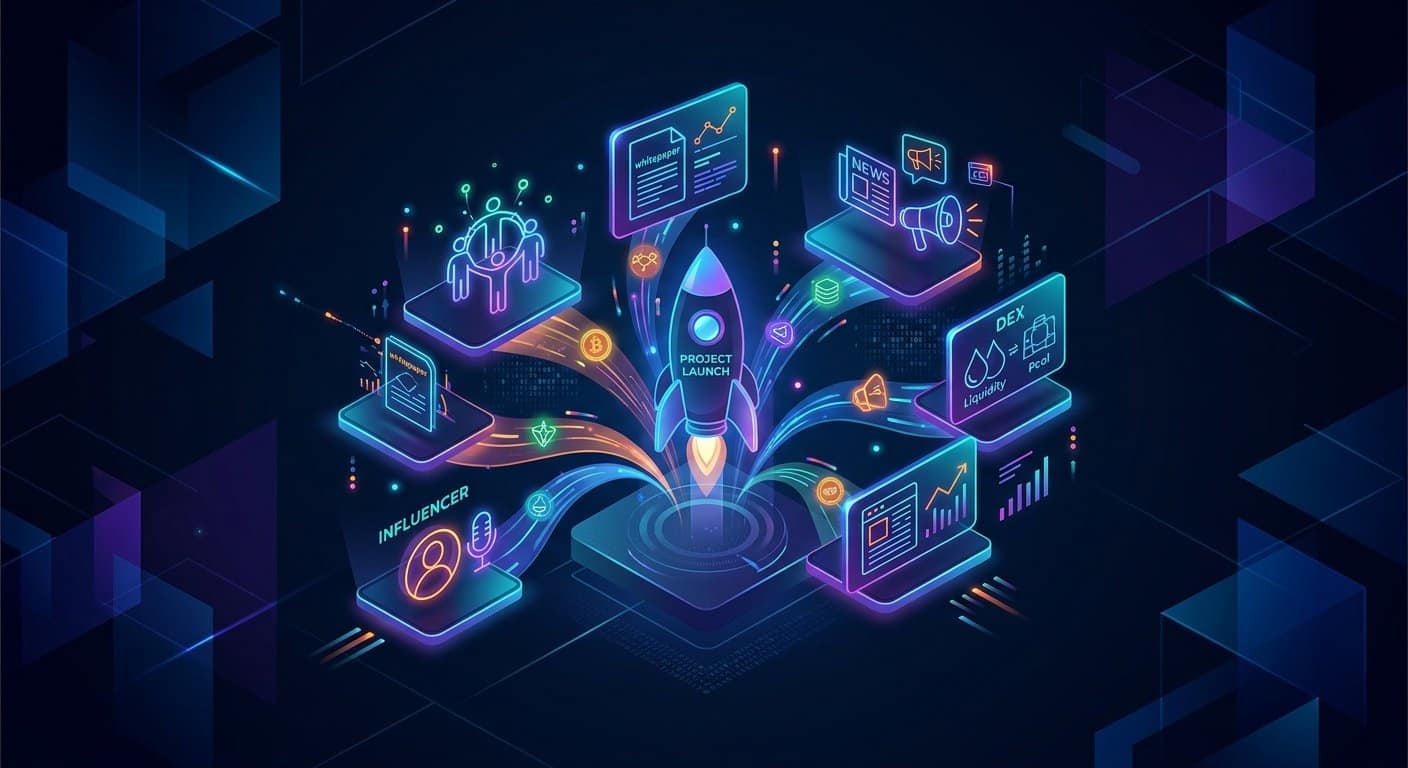
The Misconception: Many startups believe that hiring IDO marketing services means paying crypto influencers to promote their token. They allocate 60-80% of their marketing budget to influencer shoutouts, expecting that endorsements from accounts with large followings will drive their raise.
Reality: Influencer marketing represents just one component of effective IDO marketing services for startups, and when used incorrectly, it often wastes budget without generating meaningful results. The projects that successfully leverage influencers do so strategically as part of a broader credibility-building framework, not as their primary marketing tactic.
The issue with influencer-first strategies is trust erosion. Crypto audiences have become highly skeptical of paid promotions after years of influencer-promoted projects that failed or turned out to be scams. When an influencer with 100,000 followers promotes your IDO, savvy investors immediately check: Is this disclosed as a paid promotion? Has this influencer promoted 12 other projects in the past month? What happened to those projects?
Data suggests that undisclosed or poorly disclosed influencer promotions can actually harm your project’s credibility among sophisticated investors, the exact audience most likely to contribute meaningful capital to your IDO.
The Multi-Channel Foundation
Effective IDO marketing services for startups build a multi-channel foundation before layering in influencer amplification. This foundation includes:
- Technical documentation: Comprehensive whitepapers, litepaper summaries, and tokenomics explainers that allow investors to conduct due diligence
- Community infrastructure: Active Discord servers with organized channels, responsive Telegram groups, and consistent Twitter presence showing regular development updates
- Credibility signals: Team doxxing, smart contract audits from recognized firms, partnerships with established protocols, and media coverage from reputable crypto PR outlets
- Educational content: Blog posts, video explainers, and AMAs that demonstrate deep expertise in your problem domain
Only after establishing this foundation does influencer amplification deliver positive ROI. When influencers promote a project with strong fundamentals and visible credibility signals, their audiences actually convert. When they promote a project with weak documentation and no verifiable credentials, their audiences scroll past or actively criticize the obvious cash-grab.
Strategic Influencer Selection
When incorporating influencer marketing into your IDO strategy, selection criteria matter more than follower counts. Look for influencers who:
- Operate in your specific niche (DeFi, Layer 2, DEX infrastructure, etc.) rather than general crypto
- Have promoted fewer than 3-4 projects in the past 60 days, suggesting selectivity
- Demonstrate technical understanding through their content, not just price speculation
- Show engagement rates above 3-5% on their posts (likes + comments / followers)
- Maintain transparent disclosure practices for paid promotions
A single endorsement from a niche-relevant influencer with 5,000 engaged followers often outperforms five endorsements from generic crypto influencers with 50,000 followers each. YouTube crypto influencers and Twitter crypto influencers both play roles, but strategic selection based on audience alignment drives results.
Myth 3: You Can Launch Successful IDO Marketing in Two Weeks
The Misconception: Startups frequently underestimate the timeline required for effective IDO marketing. Founders often believe they can hire an agency two weeks before their token sale, run some quick campaigns, and generate sufficient investor interest to hit their raise targets.
Reality: Compressed timelines are the single biggest reason IDOs fail to meet funding goals. Projects that begin comprehensive marketing efforts 6-10 weeks before their IDO consistently raise 3-7x more capital than those starting 2-3 weeks out. The difference comes down to trust accumulation and community maturity.
Building genuine investor confidence requires multiple touchpoints over time. An investor who discovers your project, reads your whitepaper, joins your Discord to ask questions, watches your team’s AMA, sees your development updates over three weeks, and then receives your whitelist announcement is exponentially more likely to invest than someone who sees your project for the first time via a paid ad 48 hours before your sale.
According to Forbes analysis of tokenization projects, successful token launches require building stakeholder relationships well in advance of sale dates. This pattern holds particularly true for startups without existing brand recognition.
The 8-Week IDO Marketing Timeline
Effective IDO marketing services for startups follow a phased approach that maps to investor decision-making psychology:
Weeks 8-7 (Pre-Announcement Phase): Establish technical documentation, complete security audits, finalize tokenomics, and create foundational content. Begin building Discord/Telegram infrastructure and seeding initial community with beta testers or early supporters. No public IDO announcement yet.
Weeks 6-5 (Awareness Building): Announce upcoming IDO with full details. Launch content marketing (blog posts, explainer videos, infographics) across owned channels. Begin community engagement activities like technical AMAs and developer walkthroughs. Start strategic partnership announcements. Goal: Generate awareness among niche target audiences.
Weeks 4-3 (Engagement Deepening): Ramp up community activities with daily updates, Q&A sessions, and behind-the-scenes content. Launch influencer partnerships with tier-1 and tier-2 voices. Publish third-party media coverage through crypto PR channels. Host Twitter Spaces or Discord AMAs addressing investor questions. Goal: Convert awareness into genuine interest and understanding.
Weeks 2-1 (Conversion Activation): Open whitelist registration with clear instructions and deadlines. Increase posting frequency with countdown content and final opportunity messaging. Deploy retargeting campaigns to website visitors and social engagers. Conduct final comprehensive AMA addressing all remaining investor questions. Goal: Convert interested prospects into committed whitelist registrations.
Week 0 (Launch Week): Provide clear, step-by-step participation instructions. Offer real-time support for technical issues. Maintain high communication frequency with progress updates. Goal: Minimize friction and confusion during actual token purchase process.
Why Rushing Kills Conversions
When you compress this timeline into two weeks, several critical elements break down. First, you don’t have time to build organic community engagement, forcing you to rely entirely on paid promotion. Second, investors can’t complete proper due diligence, making them hesitant to commit capital. Third, you can’t iterate based on community feedback, meaning you’ll launch with messaging that doesn’t resonate.
Projects that rush also miss the compounding effect of earned media. A well-executed 8-week campaign generates organic coverage, community-created content, and word-of-mouth referrals that amplify your paid efforts. A two-week blitz relies solely on paid channels, which stop producing results the moment you stop paying.
Myth 4: All Marketing Channels Deliver Equal ROI for Startups
The Misconception: Startups often distribute their marketing budget evenly across all available channels, believing that maximum channel coverage produces maximum results. They’ll allocate equal amounts to Twitter, Discord, Telegram, YouTube, Reddit, Medium, and various ad networks, expecting proportional returns from each.
Reality: Different marketing channels produce dramatically different results for IDO campaigns, and optimal allocation varies based on your project type, target investor profile, and fundraising stage. Projects that concentrate resources on 2-3 high-performing channels consistently outperform those spreading budget thin across 7-8 channels.
The fundamental issue is channel-audience fit. Institutional investors and experienced crypto VCs conduct due diligence through different channels than retail investors. DeFi protocols attract attention through different media than infrastructure projects. Layer-2 scaling solutions find their audience in different communities than meme-oriented tokens.
| Channel | Best For | Avg Cost per Qualified Lead | Timeline to Results |
|---|---|---|---|
| Broad awareness, influencer partnerships, real-time updates | $8-$25 | 2-3 weeks | |
| Discord | Community building, technical discussions, ongoing engagement | $12-$40 | 4-6 weeks |
| Telegram | Announcement distribution, quick updates, Eastern markets | $5-$18 | 1-2 weeks |
| YouTube | In-depth explanations, technical tutorials, influencer reviews | $15-$60 | 3-4 weeks |
| Crypto Media | Credibility building, institutional awareness, SEO | $30-$150 | 2-5 weeks |
The Three-Tier Channel Strategy
Instead of equal distribution, effective IDO marketing services for startups use a tiered approach:
Tier 1 (60% of budget): Your primary conversion channels where your target investors actually make decisions. For most startups, this includes Twitter for visibility and Discord for community depth. These channels receive majority budget allocation and daily attention.
Tier 2 (30% of budget): Secondary channels that support discovery and credibility. This might include Telegram for announcement distribution, selective YouTube influencer partnerships, or targeted crypto media placements. These amplify your Tier 1 efforts.
Tier 3 (10% of budget): Experimental or maintenance channels. Reddit communities, Medium articles, LinkedIn for B2B positioning, or emerging platforms. These test new opportunities without risking core budget.
This allocation shifts based on your specific project. A DeFi protocol targeting sophisticated yield farmers might invest more heavily in Medium for technical deep-dives and Twitter for real-time updates. An infrastructure project targeting developers might prioritize GitHub visibility, technical documentation sites, and developer-focused Discord servers.
Geographic Considerations
Channel preference varies significantly by geography. Western investors heavily favor Twitter and Discord for crypto information. Eastern markets (particularly Korea, Vietnam, Thailand) rely more on Telegram and specialized local platforms like KakaoTalk. If you’re targeting global participation, your channel strategy must reflect these regional differences.
Projects attempting to raise capital from both Western and Eastern investors typically need separate marketing approaches for each region, sometimes even separate community managers who understand local communication norms and can operate during local time zones.
Myth 5: Paid Advertising Alone Can Carry Your IDO
The Misconception: Some startups believe they can bypass the slow work of community building by simply increasing their paid advertising spend. They allocate $50K-$100K to Twitter ads, Google Display Network, crypto ad networks like Coinzilla or Bitmedia, and expect direct conversion from ad impressions to token purchases.
Reality: Paid advertising for crypto projects faces unique challenges that make it far less effective than in traditional markets. Major platforms like Google and Facebook maintain strict restrictions on crypto advertising. Twitter allows crypto ads but with limited targeting options. Most crypto-specific ad networks deliver low-quality traffic with click fraud rates estimated between 20-40%.
More fundamentally, ads work poorly for high-consideration purchases like token investments. Someone doesn’t see an ad for your IDO and immediately invest $5,000. They need to research your team, understand your technology, evaluate your tokenomics, assess market timing, and compare you to alternatives. This process takes days or weeks, not the seconds between ad click and landing page visit.
Where Ads Actually Work
Paid advertising serves specific functions within IDO marketing services for startups, but not direct conversion:
Retargeting warm audiences: Ads work well for re-engaging people who visited your website, read your whitepaper, or joined your Discord but haven’t yet registered for your whitelist. These users already know your project and just need reminder nudges.
Amplifying organic content: Promoting your best-performing organic posts extends their reach beyond your followers. If a thread explaining your tokenomics generated strong engagement organically, paid promotion multiplies that success. But creating paid-only content without organic validation usually flops.
Event promotion: Ads effectively drive registrations for specific events like AMAs, launch announcements, or partnership reveals. These low-friction conversions (clicking “remind me”) work better than high-friction ones (invest now).
Geographic gap-filling: If your organic reach skews heavily toward one region but you want global participation, targeted ads in underrepresented geographies can balance your audience.
The Organic Foundation
Projects that successfully raise capital during IDOs build their foundation on organic tactics:
- Consistent content publishing: Daily Twitter threads, weekly development updates, bi-weekly blog posts on technical progress
- Active community management: Team members who genuinely engage in Discord conversations, answer questions thoroughly, and build relationships
- Strategic partnerships: Collaborations with complementary protocols that expose you to their communities
- Value-add participation: Contributing meaningfully to broader crypto conversations, not just talking about your own project
- Transparency: Regular team AMAs, public development roadmaps, honest discussion of challenges and pivots
These organic tactics create the trust foundation that makes paid amplification effective. Without this foundation, ads just broadcast your project to skeptical audiences who scroll past. With this foundation, ads remind already-interested prospects to take action.
Myth 6: Marketing Ends When Your IDO Closes
The Misconception: Startups often view IDO marketing as a finite campaign with a clear endpoint: the close of their token sale. Once they’ve raised their target capital, they dramatically reduce or completely stop marketing activities, believing the hard work is done and they can now focus purely on product development.
Reality: Post-IDO marketing is equally critical as pre-IDO marketing, just with different objectives. Projects that go silent after their token sale consistently see token price crashes, community exodus, and damaged reputations that make future fundraising or partnership development nearly impossible.
Your IDO investors didn’t just buy tokens, they bought into a long-term vision. If you disappear after taking their money, they perceive this as a rug pull even if you’re legitimately working on development. Token price reflects market confidence, and confidence evaporates without continued communication and marketing.
From campaign data across multiple Web3 projects, tokens from teams that maintain consistent post-launch marketing tend to hold 60-80% of their initial listing price after 90 days, while tokens from teams that go silent often drop to 20-40% of listing price in the same timeframe. This isn’t just about price, it’s about sustained community that you’ll need for protocol adoption, governance participation, and ecosystem growth.
The Post-IDO Marketing Shift
Post-IDO marketing serves different purposes than pre-IDO marketing:
Transparency and progress updates: Regular development updates showing concrete progress toward roadmap milestones. Weekly or bi-weekly updates work better than monthly ones, because consistent communication rhythm maintains engagement.
Community retention: Ongoing Discord/Telegram activity, AMAs addressing post-launch questions, and community initiatives that keep token holders engaged and invested in your success.
Exchange listings and liquidity: Marketing around additional exchange listings, liquidity pool expansions, or trading pair additions that improve token accessibility.
Partnership announcements: Strategic partnerships that expand your ecosystem and demonstrate real business development progress.
Use case promotion: As you launch actual product features, marketing that showcases real utility drives fundamental value beyond speculation.
Budget Reallocation, Not Elimination
Smart startups don’t eliminate marketing post-IDO, they reallocate it. Pre-IDO budgets might be $75K-$150K concentrated over 6-8 weeks. Post-IDO budgets might be $10K-$25K monthly spread over 12-18 months. The monthly spend decreases but the duration extends.
This sustained lower-intensity marketing maintains community health, supports token price stability, and positions you for future fundraising rounds or additional token sales. Projects attempting Series A fundraising or planning governance token launches 12-18 months after their initial IDO benefit enormously from maintained community and marketing momentum.
Additionally, many successful projects discover that strong post-IDO marketing creates partnership opportunities, media coverage, and ecosystem collaborations that wouldn’t have materialized if they’d gone dark. The network effects from sustained visibility compound over time.
Myth 7: Any Marketing Agency Can Handle IDO Campaigns
The Misconception: Startups sometimes hire traditional digital marketing agencies or general blockchain marketing firms, assuming that marketing expertise transfers directly to IDO campaigns. They believe that agencies successful with e-commerce, SaaS, or even general crypto awareness can deliver equal results for token sales.
Reality: IDO marketing requires highly specialized knowledge of crypto investor psychology, token economics, regulatory considerations, and Web3 community dynamics. Agencies without specific IDO experience consistently make costly mistakes that waste budget and damage credibility.
The skills required for effective IDO marketing services for startups include understanding tokenomics sufficiently to explain them to investors, navigating crypto advertising restrictions across platforms, identifying legitimate versus scam influencers in the space, managing decentralized communities, and timing campaigns around market cycles and competing token launches.
Traditional marketing agencies often apply tactics that work in Web2 but backfire in Web3. They might create overly corporate messaging that alienates crypto-native audiences, recommend advertising platforms with terrible crypto traffic quality, or suggest influencer partnerships with personalities who’ve promoted dozens of failed projects.
Evaluating IDO Marketing Expertise
When selecting IDO marketing services for startups, look for agencies that demonstrate:
Specific IDO case studies: Not just blockchain marketing case studies, but actual token launch campaigns with verifiable results. Ask for project names you can research independently, fundraising amounts they helped achieve, and references you can contact.
Deep crypto network: Established relationships with crypto media outlets, influencers who actually drive conversions, launchpad platforms, and community moderators. These networks take years to build and cannot be replicated quickly.
Technical understanding: Team members who can discuss smart contracts, tokenomics models, DeFi mechanics, and blockchain architecture competently. They need to understand what you’ve built, not just how to promote it.
Regulatory awareness: Knowledge of which claims you can and cannot make, how to handle different jurisdictions, and what disclosure requirements apply to token marketing.
Community management expertise: Experience moderating crypto communities, handling FUD (fear, uncertainty, doubt), managing scam prevention, and fostering genuine engagement rather than artificial hype.
Red Flags in Agency Selection
Avoid agencies that:
- Guarantee specific fundraising amounts or token price targets (nobody can guarantee these outcomes)
- Suggest buying followers, engagement, or community members
- Promote primarily through unnamed “exclusive networks” or undisclosed channels
- Cannot provide transparent reporting on exactly where your budget goes
- Have team members who cannot discuss crypto beyond surface-level concepts
- Recommend identical strategies for every client regardless of project type or target market
Quality agencies customize strategies based on your specific project characteristics, tokenomics, target investor profile, and competitive landscape. They ask extensive discovery questions before proposing tactics, because effective strategy requires understanding your unique context.
Should You Hire IDO Marketing Services?
✅ YES if:
- You have a genuine product with real utility beyond speculation
- Your team can allocate $25K+ to marketing over 6-10 weeks
- You’re willing to be transparent about development, team, and tokenomics
- You can commit to 12-18 months of post-IDO community engagement
- Your tokenomics have been reviewed by experienced crypto advisors
❌ NO if:
- Your project lacks working product or clear development roadmap
- You expect to raise $500K+ with under $15K marketing budget
- You’re looking for quick money grab rather than building long-term protocol
- Your team isn’t prepared to doxx or provide transparency
- You expect marketing to compensate for poor tokenomics or weak fundamentals
The relationship between your project quality and marketing effectiveness is multiplicative, not additive. Great marketing amplifies great projects exponentially, but cannot salvage fundamentally weak ones. If your tokenomics don’t make sense, your tech doesn’t work, or your team lacks credibility, no amount of marketing budget will produce sustainable results.
📋 TL;DR Summary
- Follower counts mean nothing without genuine engagement. Projects with 3,000 engaged community members raise more than those with 15,000 disengaged followers.
- Effective IDO marketing requires 6-10 weeks minimum, not 2 weeks. Rushing eliminates trust-building time that drives investor confidence.
- Focus budget on 2-3 high-performing channels rather than spreading thin across 7-8 platforms. Twitter and Discord typically deliver best ROI for startups.
- Paid advertising amplifies organic success but cannot replace community building. Spend 80% on organic, 20% on ads, not the reverse.
- Post-IDO marketing matters as much as pre-IDO. Projects that go silent after their sale see 60-80% token price drops within 90 days.
- Influencer campaigns work only when layered on top of strong fundamentals: audited contracts, comprehensive documentation, and transparent teams.
- Specialized IDO marketing agencies with verifiable case studies and deep crypto networks dramatically outperform general marketing firms applying Web2 tactics to Web3 projects.
Frequently Asked Questions
What’s a realistic marketing budget for a startup launching an IDO with $500K-$1M raise target?
For a $500K-$1M raise target, allocate $40K-$75K to marketing spread across 8-10 weeks. This breaks down roughly to: $15K-$25K for community building and management (Discord/Telegram setup, moderators, engagement programs), $10K-$20K for content creation (whitepaper design, explainer videos, infographics, blog posts), $8K-$15K for influencer partnerships (2-3 tier-1 and 4-6 tier-2 influencers), $5K-$10K for paid advertising (retargeting and event promotion), and $2K-$5K for PR and media outreach. Projects spending under $30K for this raise tier consistently underperform, while those spending over $100K often see diminishing returns unless they have complex products requiring extensive education.
How do I know if an influencer will actually convert their audience to investors or just take my money?
Require performance tracking for every influencer partnership. Provide each influencer with unique UTM-tagged links or referral codes so you can measure exactly how many people clicked through and how many completed your desired action (whitelist registration or Discord join). Check their promotion history by reviewing their past 60 days of posts. If they’ve promoted more than 5-6 projects in two months, their audience likely suffers from promotion fatigue. Examine engagement quality on their crypto posts, not just engagement rate. Do comments show genuine interest and questions, or just generic hype? Finally, verify their audience demographics match your target investor profile using tools like Twitter Analytics or requesting their media kit with audience breakdown data.
Should I prioritize Discord or Telegram for my startup’s primary community platform?
Discord works better for Western-focused projects targeting North America and Europe, projects with complex technical products requiring organized channel structure for different topics, and teams that can commit to active daily moderation and engagement. Telegram performs better for Asian-market-focused projects (particularly Korea, Vietnam, China), simpler announcement-driven communication models, and faster-moving communities that prefer chat-style interaction over forum-style organization. Many successful projects maintain both, using Discord for deep community engagement and Telegram for quick announcements and regional outreach. If you must choose one due to resource constraints, select based on your primary target market geography and communication style preference. A technically complex DeFi protocol targeting Western developers benefits more from Discord, while a straightforward token swap targeting Asian retail investors might prefer Telegram.
What percentage of my marketing budget should go to pre-IDO versus post-IDO activities?
Allocate roughly 65-70% of your first-year marketing budget to the pre-IDO phase (6-10 weeks leading up to your token sale) and 30-35% to post-IDO activities (12-18 months following your sale). This front-loading makes sense because you need concentrated effort to generate sufficient awareness and investor commitment to hit your raise target. However, the post-IDO budget, while smaller in percentage, gets spread across a longer timeline, creating sustained presence. A startup with $75K total marketing budget might spend $50K in the 8 weeks before IDO and $25K over the following year at roughly $2K-$3K monthly. Projects that spend 90%+ pre-IDO and neglect post-launch marketing see community collapse. Those that save too much for post-IDO often fail to raise sufficient capital in the first place.
How important is having a formal partnership with an established blockchain or protocol before launching my IDO?
Strategic partnerships with recognized protocols or platforms significantly boost credibility and conversion rates, particularly for startups without existing brand recognition. Investors view partnerships as third-party validation that your project has legitimate potential. In practice, projects announcing meaningful partnerships (integration with major DEX, collaboration with established DeFi protocol, endorsement from recognized blockchain foundation) before their IDO tend to raise 40-80% more capital than similar projects without partnerships. However, the partnership must be substantive, not just a logo swap or vague “collaboration.” Investors have become skeptical of announced partnerships that involve no actual technical integration, shared resources, or mutual commitment. Focus on one or two genuine partnerships where both sides actively contribute rather than collecting ten surface-level name-drops. Quality matters more than quantity, and falsely implying deeper partnerships than actually exist will damage credibility when investors investigate.
Conclusion
The gap between what startups think IDO marketing services deliver and what actually drives capital commitment is the reason most token launches underperform. Success doesn’t come from buying followers, running ads, or hoping influencers will magically convert their audiences. It comes from systematic trust-building over 6-10 weeks, strategic channel focus, genuine community engagement, and sustained communication that extends far beyond your sale date.
The startups that successfully raise meaningful capital during their IDOs share common patterns: they start marketing early enough to build real relationships, they focus resources on channels where their specific target investors actually spend time, they layer influencer amplification on top of strong organic fundamentals rather than leading with it, and they understand that marketing their project is a multi-year commitment, not an 8-week sprint.
Most importantly, effective IDO marketing services for startups require specialized expertise that general marketing agencies simply don’t possess. The regulatory landscape, community dynamics, investor psychology, and tactical execution for token launches differ fundamentally from traditional digital marketing or even general blockchain awareness campaigns.
If you’re preparing for an IDO and need marketing services that actually understand crypto investor behavior, CryptoPromo has helped numerous projects navigate successful token launches. Our team has worked across the full spectrum of IDO campaigns, from pre-launch positioning through post-sale community retention, and we understand the difference between vanity metrics and conversion drivers. Check out our crypto marketing strategy case studies to see actual results from real projects, or get a quote to discuss your specific IDO timeline and goals.
POTUS POLL’s IDO campaign exceeded expectations by filling their allocation 9x over, raising 135 SOL against a 15 SOL target through strategic community building and targeted outreach across crypto-native channels. This oversubscription demonstrates how tailored IDO marketing services can generate genuine demand for startup token launches, turning initial fundraising goals into competitive allocation events. The campaign’s success came from positioning POTUS POLL’s unique value proposition to the right Web3 audiences at the optimal time in their launch cycle.
Filled Successfully 135 SOL / 15 SOL


